
Minnesota Sentencing Guidelines Changed August 1, 2026
Written by Virginia Barron | Criminal Defense Attorney & DNA Forensic Litigator
What the New Rules Mean for Criminal History, Custody Status, Departures, and Sentencing Exposure
Minnesota's felony sentencing system changed in significant ways on August 1, 2026. The new Minnesota Sentencing Guidelines shorten the time that some prior convictions remain in a criminal-history score, remove ordinary juvenile-adjudication points, move custody status out of the criminal-history score and into a separate durational increase, create a new mitigating factor for a true first-time offender, and rerank several offenses.
A criminal-history point can change the presumptive duration of a sentence and, in some cases, whether the Guidelines recommend probation or commitment to prison. Removing a custody-status point from the horizontal criminal-history axis is especially important because custody status can still increase the length of a sentence, but it no longer moves a person horizontally across the grid and therefore does not, by itself, change the presumptive disposition.
For anyone facing a felony charge in Minnesota, sentencing analysis should begin before a plea is entered. The correct offense date, severity level, criminal-history score, custody-status modifier, mandatory-minimum rules, and possible departure grounds can all affect the real consequences of a plea or conviction.
Important effective-date point: Section 3.G says the 2026 policy modifications apply to offenses committed on or after August 1, 2026. But for earlier offenses in cases that were not yet final on August 1, a separate analysis of Minnesota's amelioration doctrine under State v. Robinette may also need to be considered. The 2026 changes have not yet generated a published appellate decision resolving that issue specifically.
How Minnesota Sentencing Guidelines Work
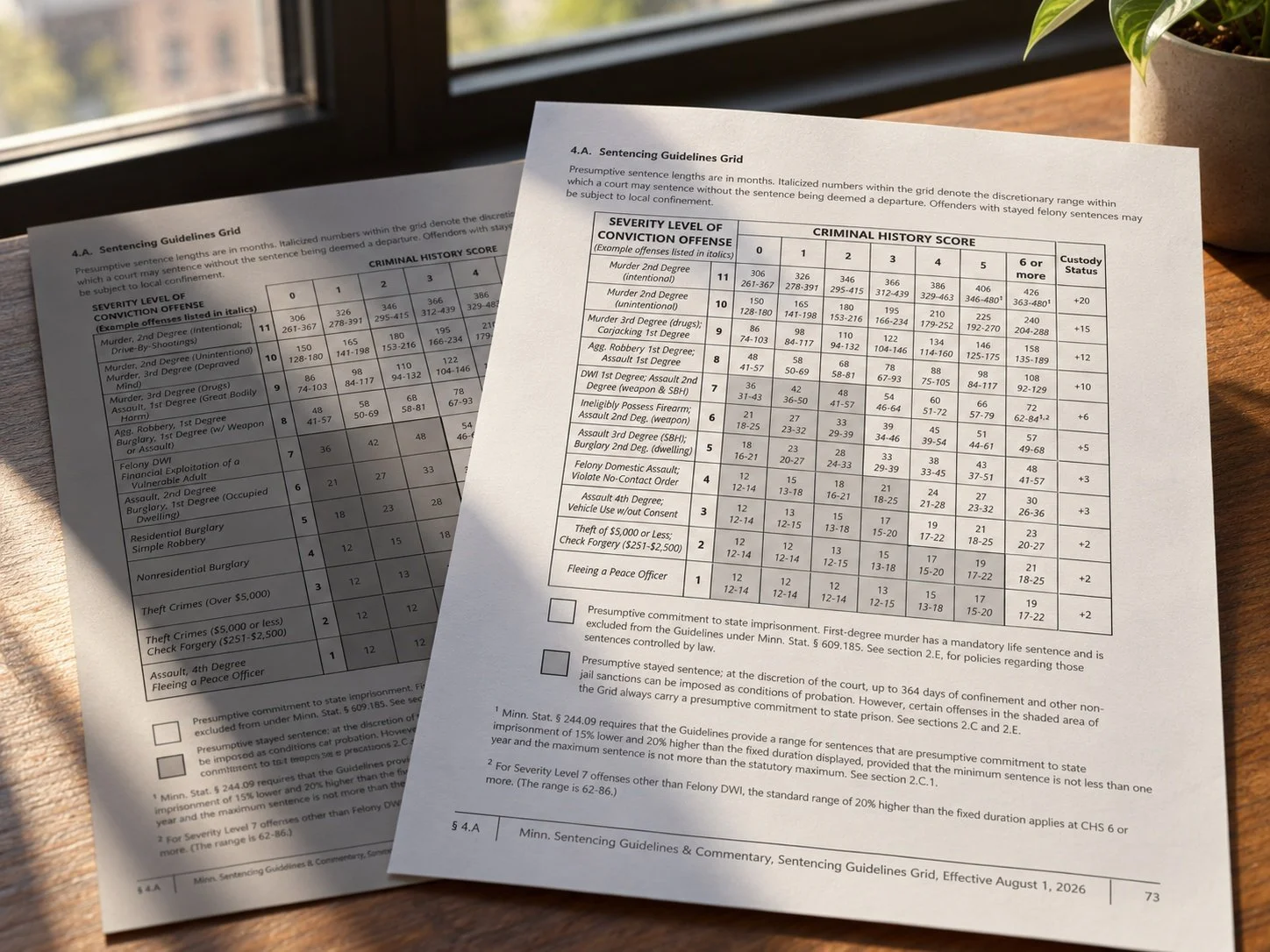
Minnesota uses three sentencing grids - the Standard Grid, Drug Offender Grid, and Sex Offender Grid - to identify a presumptive felony sentence. The current conviction offense determines the severity level on the vertical axis. The defendant's criminal-history score appears on the horizontal axis. The cell where those two meet provides the presumptive disposition, fixed duration, and presumptive range, subject to mandatory sentencing laws and any applicable modifiers.
Cells outside the shaded areas generally call for an executed prison sentence; shaded cells generally call for a stayed sentence unless another rule or mandatory minimum requires commitment. The Guidelines remain advisory in the sense that a court may depart, but a departure requires legally sufficient reasons and, under the Guidelines, substantial and compelling circumstances.
Old Felony Convictions Can Decay Sooner
One of the most important 2026 changes is the reduction of the felony decay period from 15 years to 10 years. But the rule is more precise than simply asking whether a conviction is more than 10 years old.
Minn. Sent. Guidelines § 2.B.1.c & cmt. 2.B.113 (2026) indicates that a prior felony sentence or stay of imposition must not be used in the criminal-history score if, before the current offense: (1) the prior sentence or stay of imposition expired or was discharged; (2) 10 years elapsed after the initial sentencing date for the prior felony; and (3) if the prior sentence was executed, 10 years also elapsed after the sentence expired. All applicable requirements must be met.
That distinction matters because an old prison conviction does not necessarily decay merely because 10 years have passed since the conviction date. The expiration date of an executed sentence can independently control whether the conviction still counts.
Misdemeanor and Gross-Misdemeanor History Also Decays Faster
Under Minn. Sent. Guidelines § 2.B.3.e (2026) the 2026 Guidelines shorten the decay period for qualifying misdemeanors and gross misdemeanors from 10 years to seven years. A qualifying prior generally does not count if seven years elapsed between the initial sentencing date for that conviction and the date of the current offense. A misdemeanor sentence that resulted from successful completion of a felony stay of imposition is different: the felony decay rule applies to that prior conviction.
The counting rules were also simplified. Qualifying misdemeanors and gross misdemeanors generally receive one unit each; four units equal one criminal-history point, and this component is capped at one point. The former adult DWI-specific weighting rules were eliminated, although the Guidelines retain a narrow rule excluding certain misdemeanor or gross-misdemeanor DWIs committed at ages 16 or 17 and processed in adult court. (Minn. Sent. Guidelines § 2.B.3.a, .f, .h & cmt. 2.B.301 (2026); 2026 Adopted Modifications, Part A, items 4-5.)
Ordinary Juvenile Adjudications No Longer Add Criminal-History Points
The 2026 Guidelines removed the former juvenile-adjudication component of the criminal-history score. Section 2.B.4 is now reserved, so ordinary Minnesota juvenile adjudications no longer generate juvenile criminal-history points under the Guidelines.
That does not mean every offense committed before age 18 disappears. Extended Jurisdiction Juvenile (EJJ) convictions are treated under the felony-history rules, and an offense committed as a juvenile in another jurisdiction may be included in adult criminal history if the factfinder determines that the person would have been certified to adult court had the conduct occurred in Minnesota. Adult-certified convictions also remain adult convictions. Minn. Sent. Guidelines §§ 2.B.1, cmt. 2.B.115, 2.B.5.e & cmt. 2.B.504 (2026).
Custody Status Is No Longer a Criminal-History Point
This may be the change with the largest practical effect in some cases. Before August 1, qualifying custody status could add a criminal-history point or half-point. Because criminal history runs horizontally across the grid, that extra point could increase the sentence and, in some cases, move a defendant from a shaded presumptive-stay cell into a presumptive-commit cell.
The 2026 Guidelines remove custody status from the criminal-history score. Instead, qualifying custody status produces a separate durational increase tied to the severity level of the current offense. In other words, custody status can still add months, but it does not change the criminal-history score used to determine the grid disposition. Minn. Sent. Guidelines § 2.C.2; 2026 Adopted Modifications, Part A, item 3.
The prior custody case must be a qualifying offense: generally, a felony ranked at Severity Level 3 or higher on the Standard Grid, D3 or higher on the Drug Offender Grid, any felony on the Sex Offender Grid, first-degree murder (including attempts and conspiracies), or an equivalent out-of-state felony. Qualifying custody statuses include probation, parole, supervised release, certain conditional release, release pending sentencing, qualifying confinement, and escape from confinement following an executed sentence. Minn. Sent. Guidelines § 2.C.2.a (2026).
On the Standard Grid, the custody-status increase ranges from two additional months at lower severity levels to 20 months at Severity Level 11. The Drug and Sex Offender Grids have their own custody-status columns. For a current sex offense committed while the person is under custody for a felony sex offense, the ordinary Sex Offender Grid increase is doubled. Minn. Sent. Guidelines § 2.C.2.b-c & §§ 4.A-4.C (2026).
The old Guidelines contained a specific mechanism for waiving a custody-status point in some cases. That waiver provision is gone because custody status is no longer a criminal-history point. When the new custody-status rule applies, the durational increase becomes part of the presumptive sentence. The general departure rules still exist, so this should not be confused with saying a court can never impose a different lawful sentence when substantial and compelling departure grounds are present.
Why the Custody-Status Change Can Matter So Much
Suppose a defendant was previously a presumptive prison commit only because a custody-status point moved the criminal-history score one column to the right. Under the 2026 framework, that custody status no longer changes the disposition column. The defendant may therefore remain in a presumptive-stay cell, even though the custody-status modifier increases the duration within that disposition. The same principle applies when a decayed felony or removed juvenile point lowers the score.
The result is case-specific. Other criminal history, mandatory minimums, offense-specific rules, and the current offense severity level can still make the case a presumptive commitment.
A New Mitigating Factor for a True First-Time Offender
Minn. Sent. Guideline § 2.D.3a(10) (2026) added a new mitigating departure factor when the person being sentenced has no prior criminal conviction and no prior stay of adjudication. A criminal-history score of zero, standing alone, is not enough. A person can have a zero score because convictions decayed or because prior offenses did not generate enough points.
The factor is not available for offenses ranked at Severity Levels 10 or 11 on the Standard Grid or for offenses on the Sex Offender Grid. It does not guarantee probation or a shorter sentence, but it gives courts an expressly recognized mitigating factor that can support a departure when the legal standard for departure is otherwise met.
Several Assault and Vehicular Offenses Were Reranked
The 2026 comprehensive review changed several severity-level rankings. Because severity level is the vertical axis of the grid, a reranking can change both the presumptive duration and, depending on criminal history, the presumptive disposition.
2025
2026
Assault 2nd Degree - dangerous weapon + substantial bodily harm
SL 6
SL 7
Criminal Vehicular Operation - great bodily harm; gross negligence or impairment
SL 5
SL 6
Assault 3rd Degree - substantial bodily harm
SL 4
SL 5
Domestic Assault by Strangulation
SL 4
SL 5
Felony Assault 4th Degree
SL 1
SL 3
Criminal Vehicular Homicide - qualified prior conviction
SL 8 + 50% modifier
SL 9
Assault 1st Degree - great bodily harm
SL 9
SL 8
Source: 2026 Adopted Modifications, Part A, items 8 and 10-15; Minn. Sent. Guidelines § 5.A (2026).
One important detail: the increase for fourth-degree assault applies to felony fourth-degree assault offenses. Many fourth-degree assault provisions remain gross misdemeanors unless the statute's felony conditions are met.
The Grids Now Display Presumptive Ranges in Stayed-Sentence Cells
The 2026 grids now show a presumptive range in shaded cells as well as in presumptive-commitment cells. The general range is 15 percent below and 20 percent above the fixed duration, subject to statutory maximums, mandatory minimums, and other Guidelines rules. This makes the lawful nondeparture range in stayed cases visible directly on the grids. Minn. Sent. Guidelines §§ 1.B.13.c, 2.C.1.b, 4.A-4.C (2026); 2026 Adopted Modifications, Part A, item 11.
Out-of-State Convictions: The State Has the Burden
The 2026 Guidelines now say expressly that the State has the burden of proving the facts necessary to justify consideration of an out-of-state conviction in the criminal-history score. The court then decides whether and how the conviction should be counted. The equivalent Minnesota offense is determined from the elements of the foreign offense, and an out-of-state conviction may be counted as a felony only if it would be a felony in Minnesota and the defendant received a sentence of 366 days or more, including the equivalent of a stay of imposition. Minn. Sent. Guidelines § 2.B.5.a-b & cmt. 2.B.501-.502 (2026).
That clarification is especially important after the Minnesota Court of Appeals' precedential January 2026 decision in State v. Johnson, A25-0094. Johnson held that the State does not satisfy its burden of proving the validity of out-of-state convictions and the defendant's identity as the person convicted by relying only on a presentence investigation report that does not satisfy Minnesota Rule of Evidence 1005. Because Johnson had not objected at sentencing, the court remanded and allowed the State to further develop the sentencing record. State v. Johnson, A25-0094 (Minn. App. Jan. 20, 2026)
The practical lesson is this: an out-of-state conviction in a PSI should not automatically be accepted as a valid criminal-history point. The defense should examine the actual proof, whether the foreign offense is legally equivalent to a Minnesota offense, whether the sentence satisfies the applicable Minnesota threshold, and whether a timely objection is necessary. Johnson also makes clear that an admission by the defendant can materially change the evidentiary issue, so plea and sentencing colloquies require care.nState v. Johnson, A25-0094 (Minn. App. Jan. 20, 2026); Minn. R. Evid. 1005; Minn. Sent. Guidelines § 2.B.5 (2026).
Which Version of the Guidelines Applies? Offense Date Is the Starting Point - But Not Always the End of the Analysis
Minn. Sent. Guidelines § 3.G.1 (2026) says that policy modifications apply to offenders whose offense date is on or after the specified effective date. For the 2026 package, that date is August 1, 2026. That is why two people sentenced on the same day may start with different Guidelines versions if their offenses occurred on different dates.
There is, however, a separate issue for mitigating changes and cases that were not final on August 1. In State v. Robinette, 964 N.W.2d 143 (Minn. 2021), the Minnesota Supreme Court held that the Commission's effective-date language in Guidelines section 3.G.1 and statements in a Commission report were not "statements by the Legislature" sufficient to abrogate the common-law amelioration doctrine. Robinette therefore received the benefit of a later Guidelines change that reduced his criminal-history score even though his offense predated the change.
Under the Kirby/Robinette framework, amelioration generally requires: (1) no enacted statutory language clearly abrogating the doctrine; (2) a change that mitigates punishment; and (3) no final judgment before the change took effect. Because the 2026 package includes changes that can reduce criminal history or otherwise mitigate punishment, defense counsel handling a pre-August 1 offense that was still nonfinal on August 1 should evaluate the doctrine rather than assuming the older Guidelines automatically control every issue. State v. Robinette, 964 N.W.2d 143; State v. Kirby, 899 N.W.2d 485 (Minn. 2017).
That argument should be made carefully. As of this article's August 2026 update, no published Minnesota appellate decision has yet decided how the amelioration doctrine applies to the specific 2026 comprehensive-review modifications. The analysis can also differ when a change comes directly from a new statute rather than from a Commission policy modification.
The Guidelines Also Changed Their Statement of Purpose
The Commission revised section 1.A to explain more explicitly how it views public safety and proportionality. The 2026 language states that public safety can be furthered through rehabilitation, deterrence, incapacitation, and effective community supervision, and recognizes that sanctions that hinder lawful reintegration can sometimes undermine public safety. The revised principles also say that the criminal-history score is meant to serve public-safety and proportionality goals, not to impose cumulative punishment for conduct already punished. Minn. Sent. Guidelines § 1.A (2026); 2026 Adopted Modifications, Part A, item 1.
New and Amended 2026 Crimes Were Incorporated Into the Guidelines
The Commission also incorporated felony offenses and penalty changes enacted during the 2026 legislative session. Among the sentencing-related changes are:
Coercion by a private-sexual-image threat resulting in death is ranked at SL 9; resulting in great bodily harm is ranked at SL 8.
Age deception by an adult to facilitate an offense against a minor is now an aggravating factor under Guidelines section 2.D.3.b(14).
New and amended impersonating-a-peace-officer offenses receive severity rankings ranging from SL 2 to SL 6, with a separate 12-month modifier for committing a felony while impersonating a peace officer (six months for attempt or conspiracy).
Sexual solicitation of a child by grooming, solicitation of a minor while in a position of authority, and solicitation of a student are ranked at Severity Level G on the Sex Offender Grid.
Fourth-degree assault against a hospital or clinic security guard is ranked at SL 3 when the felony provision applies.
New enhanced theft-from-a-vulnerable-adult offenses and new medical-assistance-fraud offenses received severity rankings based on the offense and amount involved.
Operating, facilitating, or advertising prediction markets was added to the list of unranked offenses.
2026 Adopted Modifications, Part C.
These legislative additions are separate from the Commission's broader criminal-history and grid-policy changes. Sentencing advice therefore still has to start with the exact statute, subdivision, offense date, and facts of the case.
Why Sentencing Analysis Should Begin Before a Plea
A sentencing worksheet is not just paperwork to review after a plea. Before advising a client about a felony resolution, defense counsel should independently verify the criminal-history score, decay dates, out-of-state convictions, severity level, custody status, mandatory minimums, and any departure factors.
That review is especially important now. A person who appeared to be a presumptive prison commit under the old rules may fall into a presumptive-stay cell after an old felony decays, a juvenile point disappears, or a custody-status point is removed from criminal history. Even when the presumptive disposition remains commitment, the duration may change significantly. The opposite is also possible when an offense was reranked upward or a custody-status durational increase applies.
Talk With a Minnesota Criminal Defense Attorney About Sentencing Exposure
The statutory maximum is only one piece of felony sentencing. The applicable Guidelines grid, offense severity, criminal history, custody status, mandatory sentencing statutes, and departure law can materially change the likely outcome. Barron Law Office represents people facing felony, assault, gun, drug, and other serious criminal charges throughout southwestern Minnesota.
If you are facing a felony case, the sentencing consequences should be calculated before you make a decision about a plea or trial. For questions about how the August 1, 2026 Minnesota Sentencing Guidelines may affect your case, contact Barron Law Office at 507-822-5735.
Frequently Asked Questions About the 2026 Minnesota Sentencing Guidelines
-
The largest changes involve criminal history and sentence calculation. Felony decay was shortened from 15 to 10 years; qualifying misdemeanor and gross-misdemeanor decay was shortened from 10 to seven years; ordinary juvenile-adjudication points were removed; custody status moved out of the criminal-history score and became a separate durational increase; a true-first-offender mitigating factor was added; several offenses were reranked; and shaded grid cells now display presumptive ranges. The Commission also incorporated new and amended 2026 crimes.
-
Section 3.G says the 2026 policy modifications apply to offenses committed on or after August 1, 2026. But that is not necessarily the end of the analysis for a mitigating change. Under State v. Robinette, a defendant with a pre-August 1 offense and a case that was not yet final when the change took effect may have an amelioration argument. Whether a particular 2026 change qualifies should be analyzed case by case.
-
A prior felony does not count merely because it is less than or more than 10 years old. Under the 2026 decay rule, the prior sentence or stay of imposition must have expired or been discharged, 10 years must have passed from the initial sentencing date, and, if the sentence was executed, 10 years must also have passed from the expiration of that sentence before the current offense.
-
Some do. Qualifying misdemeanor and gross-misdemeanor convictions generally count as one unit each, four units equal one criminal-history point, and that component is capped at one point. Under the 2026 Guidelines, those priors generally decay after seven years measured from the initial sentencing date to the current offense date.
-
Ordinary Minnesota juvenile adjudications no longer generate juvenile criminal-history points under the 2026 Guidelines. EJJ convictions are different and are treated under the felony-history rules. Adult-certified convictions and certain out-of-state juvenile offenses that would have resulted in adult certification in Minnesota may also remain relevant.
-
It was removed from the criminal-history score. Qualifying custody status now adds a set number of months to the presumptive duration based on the current offense row. Because it no longer increases the criminal-history score, it does not by itself move a defendant from a presumptive-stay cell to a presumptive-prison cell.
-
Yes. The 2026 Guidelines use custody status as a durational increase. The amount varies by grid and severity level. For qualifying sex offenses committed while the defendant is under custody for a felony sex offense, the Sex Offender Grid custody-status increase is doubled.
-
The new mitigating factor applies when the person has no prior criminal conviction and no prior stay of adjudication. A criminal-history score of zero is not enough by itself. The factor is unavailable for Standard Grid Severity Levels 10 and 11 and for offenses on the Sex Offender Grid.
-
Not if the PSI is the only proof and does not satisfy Minnesota Rule of Evidence 1005. In the precedential 2026 decision State v. Johnson, the Court of Appeals held that the State did not meet its burden by relying solely on that kind of PSI to establish the validity of the out-of-state convictions and the defendant's identity as the person convicted. A defendant's admission can change the analysis, which is why timely review and objection matter.
-
They can in some cases, but not automatically. If a defendant was in a presumptive-commit cell only because of a custody-status point, an old felony that now decays, or a juvenile point that no longer exists, the new calculation may place the case in a presumptive-stay cell. Mandatory minimums, other criminal history, offense-specific rules, and the applicable offense date can change the result.
-
No. Some changes reduce criminal history or lower a severity ranking, while others increase severity levels or add new penalty rules. For example, first-degree assault resulting in great bodily harm moved from SL 9 to SL 8, while second-degree assault with a dangerous weapon causing substantial bodily harm moved from SL 6 to SL 7.
-
As soon as you are charged. Sentencing exposure can affect plea strategy, whether an offer is actually favorable, and what issues need to be preserved. Virginia "Ginny" Barron of Barron Law Office represents people facing criminal charges in southwestern Minnesota and reviews Minnesota felony sentencing issues as part of case strategy, including criminal-history calculations, Guidelines exposure, and forensic-evidence issues when they are relevant.
Sources and Authorities
Minnesota Sentencing Guidelines Commission, 2026 Report to the Legislature (Jan. 15, 2026).
State v. Johnson, A25-0094 (Minn. App. Jan. 20, 2026) (precedential).
General information only. This article discusses Minnesota law and the Minnesota Sentencing Guidelines as of August 2026. It is not legal advice for any particular case. Sentencing depends on the offense date, conviction offense, criminal history, statutory requirements, and case-specific facts.
Related Barron Law Office resources: Felony Defense in Minnesota | Minnesota Assault Defense | Minnesota Criminal Defense