

MINNESOTA DNA ATTORNEY | FORENSIC DNA DEFENSE STATEWIDE
The Science Can Be Accurate and Still Legally Misleading.
If DNA evidence is being used against you or someone you love, it can feel like the case has already been decided. A reported “match,” or an enormous statistical number can sound devastating. A laboratory result is not the whole case. The important questions are what the DNA actually proves, what it does not, how it may have gotten there, and whether the State is asking the science to support more than it can.

WHEN DNA EVIDENCE FEELS OVERWHELMING
The science may feel incomprehensible right now. Call me. I can help you make sense of it.
You may be hearing words like “DNA match,” “cannot exclude,” “likelihood ratio,” “more than 100 billion times more likely,” “mixture,” or “STRmix.”
You may have been shown a number so large that it sounds impossible to overcome.
And you may be wondering whether there is anything left to defend.
It is reasonable to be frightened by that.
But those words and numbers do not answer every question that matters in a criminal case. My job is to look beneath the laboratory’s conclusion at the actual data and explain what it really means in language you can understand.
Before you assume the worst, the evidence deserves to be understood.
WHAT CAN DNA ACTUALLY PROVE?
Finding DNA Is Not the Same as Establishing What Happened.
DNA evidence can be powerful. But its legal significance depends on far more than whether a person’s DNA was detected.
PRESENCE IS NOT ACTIVITY
DNA testing may help answer who could have contributed DNA to a sample. By itself, it often cannot tell when the DNA was deposited, how it got there, what activity caused it to be there, or whether the person committed the charged offense.
A LARGE NUMBER IS NOT GUILT
A likelihood ratio can sound conclusive because the number may be enormous. But it is not the probability that the accused is guilty. And it does not tell us when or how the DNA was deposited.
CONTEXT CHANGES MEANING
Transfer, mixtures, where the sample was collected, how evidence was handled, assumptions made during interpretation, and the rest of the evidence can all change what a DNA result actually means.
Evidence Never Exists in Isolation.
how i review a DNA case
I Do Not Rely on the Laboratory’s Conclusion(s).
A laboratory report is a summary of the laboratory’s conclusion(s). It is not the entire underlying DNA case file.
I work through the evidence from the beginning to determine what the science actually supports, what questions the evidence raises, and how it fits within the case as a whole. I use the Barron Forensic Integrity Protocol™ to guide that review.

Why Ginny Barron?
More Than a Decade Focused on Forensic DNA in Criminal Cases.
I have spent more than a decade working with forensic DNA evidence in criminal cases.
My work has included laboratory files and raw data, DNA mixtures, probabilistic genotyping and STRmix, likelihood ratios, laboratory procedures and validation information, contamination issues, admissibility, and the courtroom presentation of DNA evidence.
I have served on Minnesota’s statewide public defense DNA team and continue to work with defense attorneys on forensic DNA cases throughout Minnesota. I am a Fellow of the American Academy of Forensic Sciences and have served in leadership roles within its Jurisprudence Section. I also teach and train lawyers on forensic DNA issues and have participated in national forensic-science education.
But credentials are not the point.
What matters is what that experience allows me to do in your case: look beyond the conclusion, identify the questions that matter, and explain the evidence in a way you can understand.
PRETRIAL DNA LITIGATION
Sometimes the Most Important DNA Work Happens Before a Jury Ever Hears About It.

Some DNA issues need to be addressed before trial. That may involve how the evidence was tested or interpreted, whether an adequate scientific foundation exists, how a statistical result may be presented, or whether the State is asking the evidence to support a conclusion the science does not establish.
When the evidence supports it, I litigate those issues before trial.
Early review matters because meaningful forensic litigation usually cannot begin the night before trial.
Not All DNA Evidence is Worth Challenging, But More of it is Than You Think →
Frequently Asked Questions | DNA & Forensics
Questions Clients and Families Often Ask

-
No. DNA evidence may establish a biological association with a sample, depending on the result, but guilt is a legal conclusion based on all of the evidence. DNA ordinarily does not establish by itself when biological material was deposited, how it was deposited, why it was present, or what activity occurred.
DNA Evidence in Criminal Cases: Why Presence Is Not the Same as Guilt →
-
The word “match” can oversimplify what a laboratory actually reported. Different types of DNA results are expressed in different ways. The laboratory report, underlying data, statistical conclusion, sample type, and circumstances of the case all matter when determining what the result actually means.
-
It can. Biological material can sometimes be transferred indirectly through other people or objects. A person’s DNA may also be detected in places where they regularly live, work, or spend time. Whether transfer is a reasonable explanation in a particular case depends on the circumstances and the scientific evidence.
Learn more: DNA Transfer in Shared Living Spaces →
-
Sometimes an independent forensic expert is necessary and sometimes it is not. I first review the DNA evidence to determine what issues exist and whether additional scientific expertise, testing, or testimony would materially help the defense.
-
STRmix is probabilistic genotyping software used to assist with interpretation of DNA mixtures. It uses statistical modeling and can generate a likelihood ratio comparing competing propositions about the DNA evidence. It does not determine guilt or tell the jury how or when DNA was deposited.
-
A likelihood ratio compares how well the DNA evidence is supported under two competing propositions. It is a measure of the strength of the DNA evidence under those propositions. It is not the probability that the accused is guilty and should not be interpreted that way.
-
As early as possible. Early review can help identify missing discovery, additional laboratory materials that should be requested, issues requiring investigation, and questions that may need to be litigated before trial. If the case is already further along, however, that does not necessarily mean it is too late to review the DNA evidence.
READ MORE ABOUT FORENSIC DNA
Want to Understand the Science More Deeply?
For clients and families who want to understand the science in greater detail, I write about Forensic DNA issues and forensic evidence in Minnesota criminal cases.
What Happens When the DNA Matches But You Are Innocent?
Read Post

Understanding STRmix and DNA Mixture Interpretation in Court
Read Post
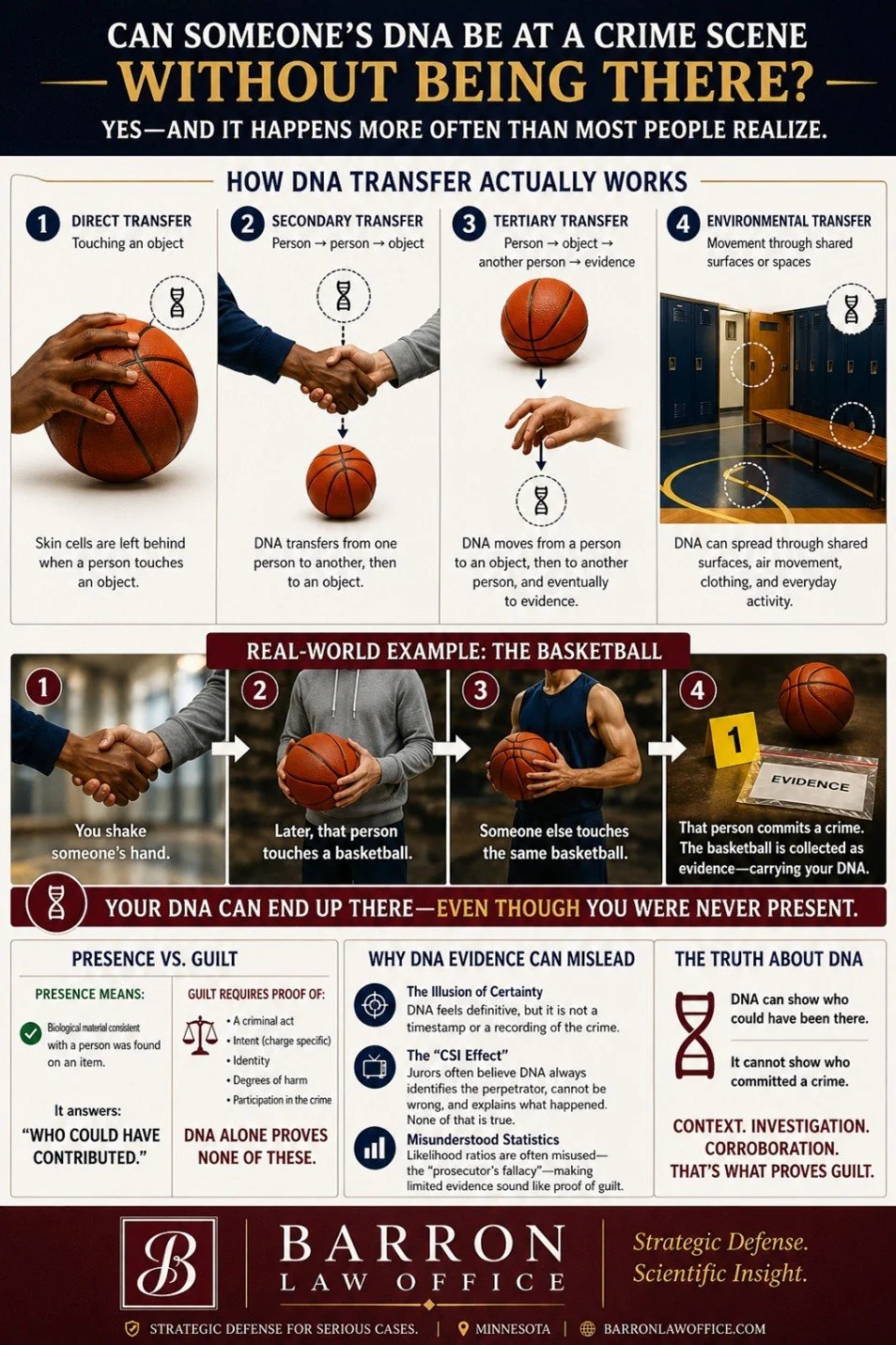
DNA Evidence in Criminal Cases: Why Presence Is Not The Same as Guilt
Read Post

WHEN DNA EVIDENCE FEELS OVERWHELMING
Start by Finding Out What It Actually Means.
You do not have to understand STRmix, laboratory procedures, DNA mixtures, or likelihood ratios before you call me.
That is my job.
If you or someone you love is facing a criminal case involving forensic DNA evidence anywhere in Minnesota, we can start with a conversation about what has happened, where the case stands, and what needs to be reviewed.
I handle forensic DNA matters statewide in Minnesota.
Email: ginny@vbarronlawoffice.com
Are You a Criminal Defense Attorney?
I also consult with defense attorneys and partner with them regarding forensic DNA cases throughout Minnesota.