
Written by Virginia Barron | Criminal Defense Attorney & DNA Forensic Litigator
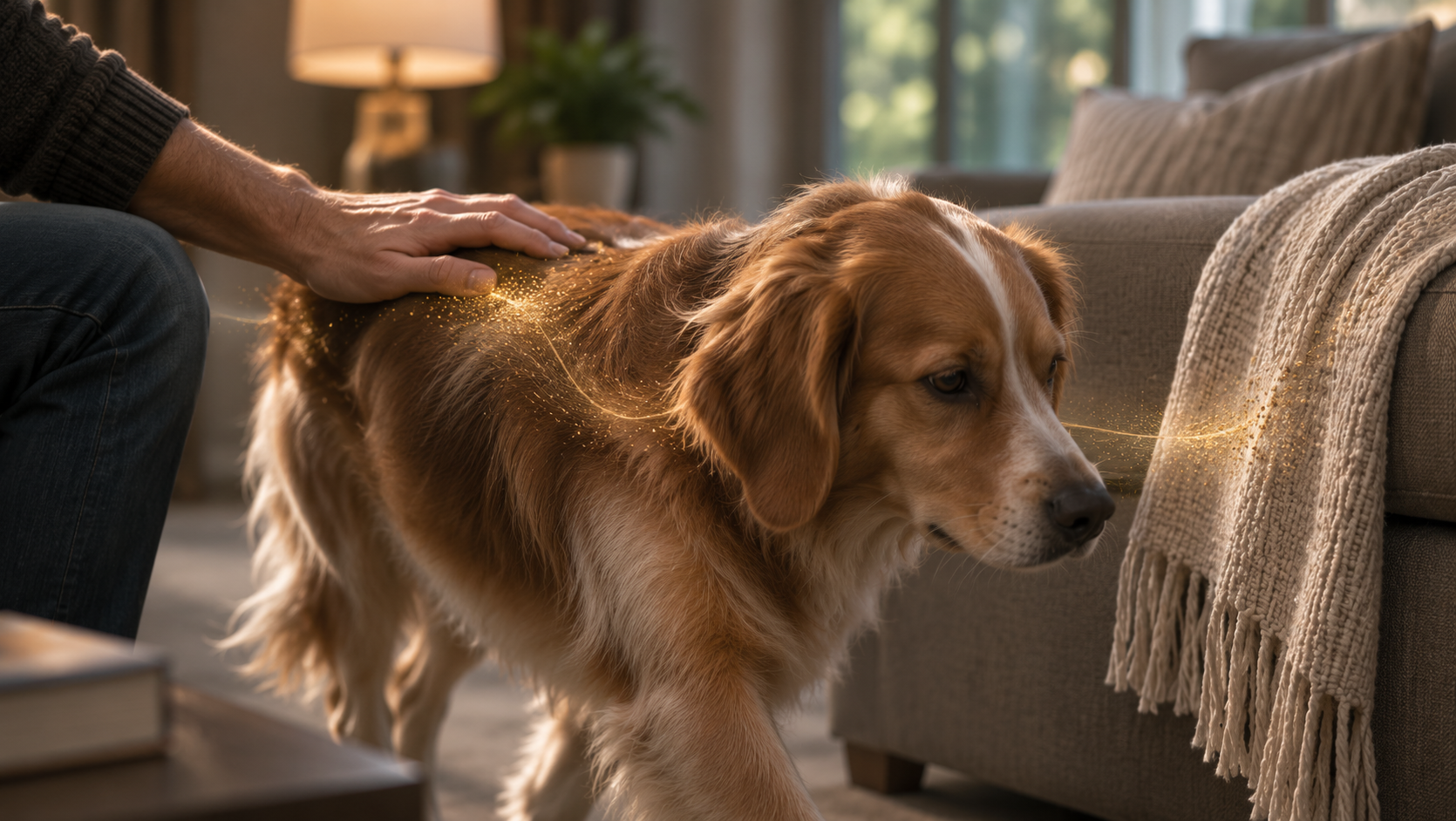
What Dogs and Cats Reveal About Secondary DNA Transfer
Recent forensic studies show that household pets can carry human DNA and transfer it to other surfaces - a reminder that where DNA is found does not necessarily tell us how it got there.
A person does not necessarily have to touch the ultimately tested item for that person's DNA to arrive there. A household pet can be one of the intermediaries that moves DNA through an ordinary environment.
DNA evidence is often discussed as though the path from a person to an object is straightforward: someone touches an item, leaves DNA behind, and that DNA is later recovered. Real environments are more complicated.
People touch other people. They touch clothing, furniture, bedding, floors, phones, tools, and countless other surfaces. Biological material can move between those surfaces. And in homes with pets, there is another potential intermediary that is easy to overlook: the dog or cat moving through the same environment.
Two recent peer-reviewed studies examined human DNA on household dogs and cats. Both found that pets can carry human DNA on their fur. Both also experimentally demonstrated that human DNA can move between a person and an animal, and from the animal to another contacting surface. The researchers describe household pets as potential reservoirs and vectors of indirect human DNA transfer. (Monkman, Szkuta & van Oorschot, 2023, pp. 1, 11-12; Monkman, van Oorschot & Goray, 2025, pp. 1, 6.)
I have written before about touch DNA and secondary transfer in Minnesota criminal cases. These pet studies add a particularly concrete example of how indirect transfer can occur in a shared living environment.
Human DNA Was Found on Every Dog in the Study
The 2023 dog study involved 20 household dogs from 20 separate homes. Researchers sampled six areas of each dog to evaluate the general presence of human DNA. They also tested whether DNA could move from a person to a dog during a brief patting event and whether human DNA already present on the dog could move from the dog to a clean gloved hand or to a clean sheet the dog walked across. (Monkman, Szkuta & van Oorschot, 2023, pp. 2-3.)
Human DNA was recovered from all 20 dogs. Among the 120 direct samples collected from the dogs, the profiles that could be assigned a minimum number of contributors were predominantly two-person mixtures. DNA from unknown sources was observed in 39.2% of the 120 profiles generated directly from the dogs. (Monkman, Szkuta & van Oorschot, 2023, pp. 5-7, 9.)
That does not mean the dogs were covered in large quantities of human DNA. The quantities were generally small, and many samples produced limited or no useful profiling information. But the finding matters because it shows that a household animal can accumulate DNA from multiple people - including people who were not accounted for by the household reference samples. (Monkman, Szkuta & van Oorschot, 2023, pp. 5-7, 10.)
Dogs Could Transfer Human DNA to a New Surface
The researchers then tested whether the dog could act as an intermediary. A researcher wearing a new glove patted and scratched each dog. Human DNA transferred from the dog to the glove at a detectable level in 19 of 20 experiments. Thirteen of those glove profiles could be analyzed further. The resulting profiles included DNA from household members and, in some instances, unknown sources. (Monkman, Szkuta & van Oorschot, 2023, pp. 9, 11.)
The researchers also had each dog walk repeatedly across a clean plastic sheet. That pathway was less efficient: many sheet samples contained no detectable DNA or too little information for interpretation. Still, interpretable profiles were obtained from some sheets, including DNA from household members and unknown sources. The authors concluded that dogs may need to be considered as vectors for indirect human DNA transfer in appropriate case scenarios. (Monkman, Szkuta & van Oorschot, 2023, pp. 9, 11-12.)
The 2025 Cat Study Found the Same Broader Phenomenon
A 2025 follow-up study examined 20 cats from 15 households. Researchers collected background samples from four locations on each cat and separately tested transfer from a cat to a clean glove and from a person to the cat during a brief patting event. (Monkman, van Oorschot & Goray, 2025, pp. 1-2.)
Human DNA was detected on every cat. Across the 80 background samples, quantifiable human DNA was recovered from 69%. Detection was particularly common on exposed fur: 95% of back samples, 90% of head samples, and 80% of the right-side fur samples contained detectable DNA. Only 10% of samples taken from the skin at the base of the fur contained detectable DNA. (Monkman, van Oorschot & Goray, 2025, p. 3.)
Among the cat background profiles containing five or more alleles, the owner was detected in 79%. But DNA from an unknown source was detected in 47% of those profiles. In 21% of the samples, an unknown donor appeared as the only, major, or majority contributor. (Monkman, van Oorschot & Goray, 2025, pp. 4-6.)
A Cat Could Move an Owner's DNA to Someone Else
The cat-to-glove experiment is an especially clear illustration of indirect transfer. The researcher briefly patted each cat while wearing a new glove and then tested the glove. Quantifiable human DNA was detected on 16 of the 20 gloves. Fourteen produced profiles containing at least five alleles. In most interpretable samples, the transferred DNA included an owner of the cat; unknown contributors were also detected. (Monkman, van Oorschot & Goray, 2025, pp. 4-5.)
The authors describe this as, at minimum, a transfer pathway from the owner to the pet and then from the pet to the glove. In other words:
Person A → Cat or dog → New surface
That is a secondary-transfer pathway. The person whose DNA ultimately appears on the new surface may never have touched that surface at all. The cat study therefore concludes that pets can act as intermediary vectors of human DNA transfer and that this possibility may need to be considered when DNA from a crime scene is being evaluated in a home where animals are present. (Monkman, van Oorschot & Goray, 2025, p. 6.)
DNA Is Not a Chronological Record of Who Touched Something Last
The studies also illustrate another important limitation of touch DNA: the resulting profile does not function as a timestamp or a chronological list of contacts.
In the cat study, the last person known to have contacted the cat was detected in 27 of the 43 background samples that produced profiles with at least five alleles. That means the most recent known contact was not detected in 16 of those 43 profiles. In the dog study, the main household person was generally the last person to contact the dog before sampling, but that person was observed in only 35.8% of the 120 profiles generated directly from the dogs. (Monkman, van Oorschot & Goray, 2025, p. 4; Monkman, Szkuta & van Oorschot, 2023, p. 8.)
Even a known direct contact did not guarantee recovery of that person's DNA. In the dog experiment, the person who deliberately patted the dog was detected in 10 of the 20 resulting profiles. In the cat experiment, the DNA of the person who briefly patted the cat was detected in 5 of the 20 contact experiments when the profiles were evaluated under the study's reporting approach. (Monkman, Szkuta & van Oorschot, 2023, pp. 8-10; Monkman, van Oorschot & Goray, 2025, pp. 5-6.)
The lesson is not that DNA is unreliable. The lesson is that DNA deposition is influenced by many variables. The last person to touch something may not be detected. A prior person may remain detectable. DNA from someone else may already be present. And biological material can sometimes reach a new location through an intermediary.
Why This Matters in a Shared Home
The potential significance becomes easier to see in an ordinary household. A dog or cat may be petted by several people, sleep on beds or couches, brush against clothing, walk across floors, move between rooms, or interact with visitors. Human DNA can accumulate on the animal and later move again when the pet contacts a person or surface.
That does not prove that a pet explains any particular DNA result. But when DNA recovered from an object is being used to establish contact, possession, presence, or participation in an alleged crime, the possible transfer pathways may matter - especially in a shared living environment where the people involved and the animal interact with many of the same surfaces.
The 2023 dog paper specifically notes that dogs may act as vectors moving human DNA from one room to another or potentially from one person to another surface. The 2025 cat paper similarly cautions that DNA results from crime scenes where pets are present may need to be evaluated in light of possible transfer through an animal intermediary. (Monkman, Szkuta & van Oorschot, 2023, p. 1; Monkman, van Oorschot & Goray, 2025, p. 6.)
What These Studies Do - and Do Not - Establish
These are useful studies, but they should not be stretched beyond what they actually tested.
They demonstrate that household dogs and cats can carry human DNA on their fur.
They demonstrate that human DNA can transfer from a pet to another contacting surface under the experimental conditions used.
They show that the DNA profile recovered from an animal does not necessarily identify the most recent person who touched it.
They show that DNA from unknown people can sometimes be present on household pets.
They do not establish that a pet caused the DNA finding in any particular criminal case.
They do not provide a universal probability that a specific person's DNA will move through a pet to a specific object under real-world case conditions.
Both papers are preliminary studies involving 20 animals. The authors repeatedly call for additional research into persistence, different surfaces, different contact scenarios, grooming and washing, animal characteristics, and the probabilities associated with case-specific transfer pathways. (Monkman, Szkuta & van Oorschot, 2023, pp. 10-12; Monkman, van Oorschot & Goray, 2025, pp. 6-7.)
Questions Defense Attorneys Should Ask When a Pet Is Part of the Environment
If a dog or cat was present in the home or regularly interacted with the people and objects involved in the case, the animal may be part of the transfer environment. Depending on the facts, useful questions can include:
Who regularly handled or petted the animal?
Where did the animal sleep, lie down, or spend time?
Did the animal move freely between rooms?
Did the animal contact bedding, clothing, furniture, bags, or other items later collected as evidence?
Was the person whose DNA was detected a household member or frequent visitor?
Could the animal have contacted both that person and the tested item?
What other transfer pathways existed in the home?
Is the prosecution treating the presence of DNA as though it necessarily proves direct contact?
Is there enough case-specific scientific data to assign any probability to the proposed pet-mediated transfer pathway?
Those questions do not establish that indirect transfer actually occurred. They help define the difference between demonstrating that a person's DNA is present and determining how that DNA got there.
The Finding Is Real. The Pathway May Still Be Uncertain.
The most useful lesson from these studies is that biological material moves through ordinary environments in ways that are not always obvious.
A DNA profile may strongly support that a person contributed biological material to a sample. That can be important evidence. But the DNA comparison does not, by itself, identify every step that carried the biological material to the surface where it was eventually collected.
Sometimes the route is direct. Sometimes it may involve another person, an object, clothing, a surface - or even the family dog or cat.
When the prosecution's theory depends not merely on whose DNA was found but on what that DNA supposedly proves about contact, possession, or activity, the transfer pathway deserves its own analysis.
Frequently Asked Questions About Pets and Secondary DNA Transfer
-
Yes. In a 2023 pilot study, researchers recovered human DNA from all 20 household dogs tested and demonstrated that human DNA on a dog could transfer to a clean gloved hand during brief contact. The study shows that dogs can act as intermediary vectors of human DNA transfer, although it does not prove that this happened in any particular case. (Monkman, Szkuta & van Oorschot, 2023, pp. 9, 11-12.)
-
Yes. A 2025 study found quantifiable human DNA on 16 of 20 clean gloves after the researcher briefly patted a household cat. The authors described this as indirect transfer through the cat and concluded that cats can act as intermediary vectors of human DNA transfer. (Monkman, van Oorschot & Goray, 2025, pp. 4-6.)
-
No. DNA can sometimes reach an object through indirect or secondary transfer. A DNA result may provide strong information about whose DNA is present while still leaving a separate question about how the biological material arrived on the tested surface.
-
Yes, it is possible. Both studies detected DNA from unknown contributors on household pets. In the cat study, unknown DNA was detected in 47% of the background profiles containing five or more alleles, and in the dog study unknown contributors were also common. The studies could not identify the origin of every unknown contribution. (Monkman, van Oorschot & Goray, 2025, pp. 4-6; Monkman, Szkuta & van Oorschot, 2023, pp. 7, 10.)
-
No. The cat study did not detect the last known person to contact the cat in 16 of 43 informative background profiles. The dog study also found that recent contact did not reliably determine which person appeared in the resulting DNA profile. DNA is not a simple chronological record of when someone touched something. (Monkman, van Oorschot & Goray, 2025, p. 4; Monkman, Szkuta & van Oorschot, 2023, p. 8.)
-
Potentially, yes. The dog researchers specifically identified movement between rooms as a plausible way a household dog could act as a DNA vector. The studies establish that pets can carry and transfer human DNA, but they do not calculate the probability of a particular room-to-room transfer in a specific case. (Monkman, Szkuta & van Oorschot, 2023, p. 1.)
-
Not by itself. These studies show that pet-mediated transfer is scientifically possible, not that it occurred in a particular case. A case-specific evaluation would need to consider who interacted with the animal, what surfaces the animal contacted, timing, DNA quantities, profile composition, and other possible transfer pathways.
-
It can matter when the prosecution uses DNA to argue that a person directly touched an item, possessed it, or was present during a particular event. If a pet could have carried DNA between people and surfaces, the pathway by which the DNA arrived may be a separate forensic question from whose DNA was detected.
Sources and Further Reading
1. Monkman, H., Szkuta, B., & van Oorschot, R.A.H. (2023). Presence of Human DNA on Household Dogs and Its Bi-Directional Transfer. Genes, 14, 1486. https://doi.org/10.3390/genes14071486
2. Monkman, H., van Oorschot, R.A.H., & Goray, M. (2025). The Role of Cats in Human DNA Transfer. Forensic Science International: Genetics, 74, 103132. https://doi.org/10.1016/j.fsigen.2024.103132