



Understanding What Touch DNA Really Shows — and What It Doesn’t — in Minnesota Criminal Cases
When jurors hear that someone’s DNA was found on an object connected to a crime, a common assumption is that the person must have touched that object during the crime. That assumption is rooted in decades of television dramas, sensational true-crime storytelling, and simplified courtroom rhetoric that treats DNA as incontrovertible proof of action. But touch DNA and trace DNA (genetic material left behind from skin cells, sweat, or minute contact) must be understood in context. It does not inherently prove that someone physically handled an object at a specific time or participated in the criminal act being investigated.
The real issue is this: DNA evidence is powerful — but it is also easily misunderstood and frequently overstated. In the realm of forensic science, DNA is not a smoking gun unless it is combined with other corroborating evidence that links a person’s behavior to the crime. In isolation, DNA is only indicative of presence — not intent, timing, or conduct. Too often, the phrase “DNA match” is repeated as if it is synonymous with guilt, despite its technical meaning being far more limited.
In this post, I’ll explain what touch DNA actually is, how DNA can be transferred indirectly — including through secondary and tertiary mechanisms — and why courts must interpret such evidence with an informed, critical lens. I’ll explore the science of DNA mixtures, how probabilistic genotyping works, why simplistic statistics can mislead, and how innocent people have been wrongly implicated because the limitations of touch DNA were not effectively communicated. Along the way, we’ll look at real case examples that show how touch DNA, when misinterpreted, has had devastating consequences.
What Is Touch DNA?
Touch DNA (also called trace DNA) refers to the minute quantities of genetic material left behind when a person comes into any contact with a surface — even if that contact was casual, fleeting, or days earlier. Unlike visible stains, touch DNA comes from microscopic skin cells or bodily secretions that modern DNA testing can detect with increasing sensitivity. While this technological ability is a powerful investigative tool, it also raises interpretative challenges.
For example, in everyday life humans shed anywhere from millions to a billion skin cells every day. The level of DNA an individual transfers to untouched items in their immediate surroundings – ScienceDirect
When you open a door, grip a coffee cup, or sit in a chair, microscopic bits of your DNA can be left behind. Advances in forensic testing have made it possible to generate a partial or full genetic profile from surprisingly tiny samples — sometimes from fewer than 100 cells. This high sensitivity means that samples once considered too insignificant for testing are now routinely analyzed in criminal labs.
However, the presence of touch DNA alone does not tell us how the DNA got there. Did the suspect handle the object directly during the crime? Were they present at some earlier time? Or did someone who touched them later handle the object, transferring their DNA indirectly? These questions cannot be answered by DNA profiling alone; they require careful contextual analysis that goes beyond the science.
Touch DNA vs Direct Contact: The Misconception
It might seem intuitive that if a person’s DNA is on an object, they must have touched it. But this assumption ignores the reality of DNA transfer dynamics. Touch DNA demonstrates presence of genetic material, not proof of behavior. It cannot indicate timing — when the DNA was deposited — nor the circumstances under which it arrived.
Consider, for example, a coffee cup touched by Person A at a work meeting. Later that same day, Person B handles the cup and leaves a mix of cell material. If law enforcement were to find Person A’s DNA on that cup in connection with a later criminal investigation, the presence of that DNA would not conclusively show that Person A touched the cup at the relevant time in question; it only shows that their genetic material was present somewhere on the object.
In legal settings, this distinction often gets lost. Jurors hear “DNA found” and instinctively equate that with direct involvement in the crime. But scientifically, touch DNA only shows that a person’s genetic material was present on an item sometime before collection — without indicating how it got there or whether it was deposited during the alleged offense. Recognizing this difference is crucial for fair evaluation of evidence.
Secondary and Tertiary DNA Transfer
Even more complex than primary touch is the reality of secondary and tertiary transfer — mechanisms by which DNA can move from one person to another object indirectly. Secondary transfer occurs when Person A’s DNA is picked up by Person B through some contact and then later deposited onto an object. Tertiary transfer involves an additional step: Person A’s DNA moves to Person B, then to Person C or another surface, before ending up on the evidence in question.
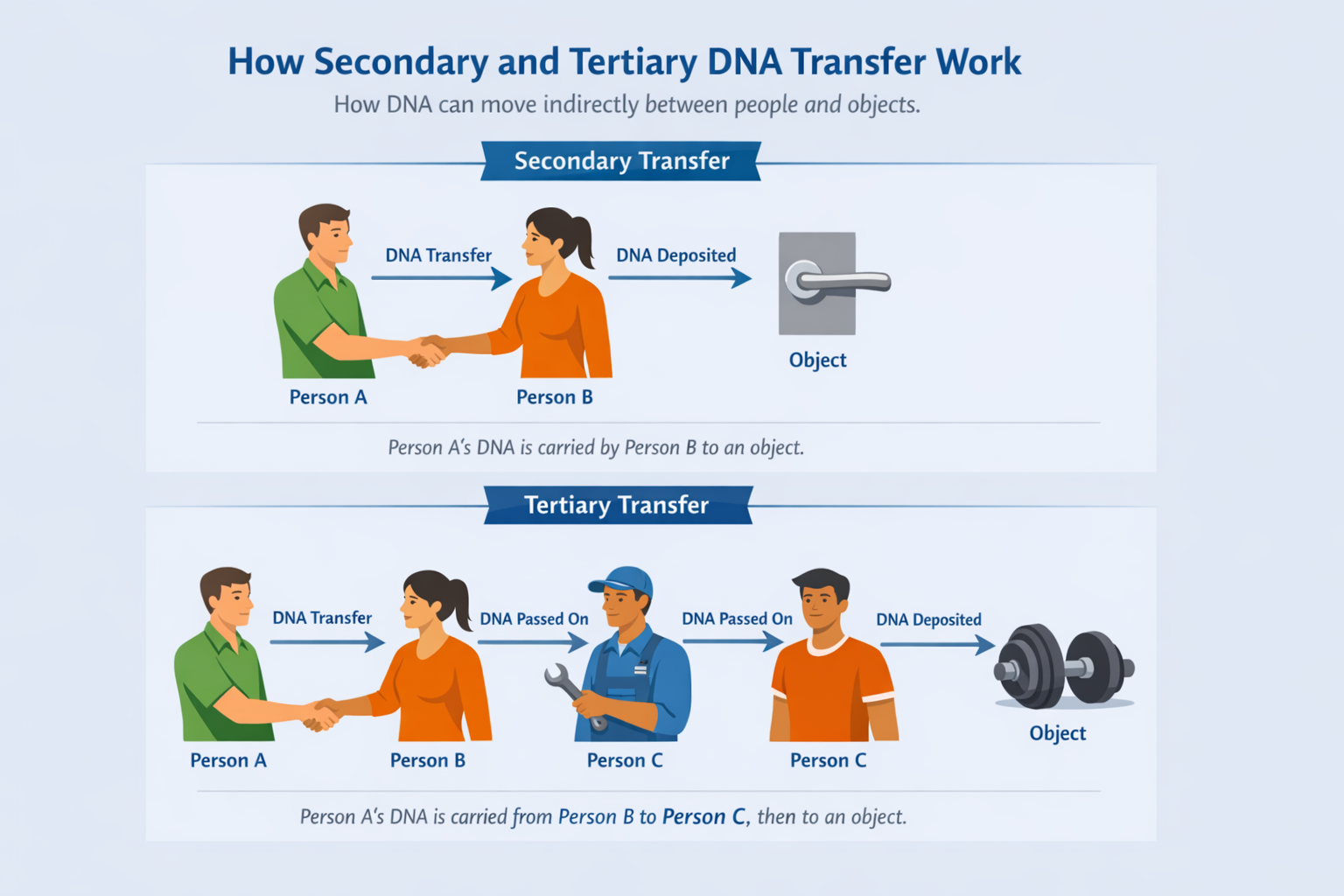
One of the most striking real-world examples of secondary transfer occurred in the case of Lukis Anderson. In 2012, Anderson was charged with murder in California after his DNA was found on the victim’s fingernails, despite a solid alibi placing him in a hospital under supervision when the crime occurred. Investigators later determined that paramedics who had treated Anderson earlier that day were the likely carriers of his DNA — inadvertently depositing it at the crime scene hours later when they responded to the murder. His DNA was literally transferred by first responders who had touched him and then the victim, illustrating how easily DNA can be misinterpreted when context is missing.
Secondary DNA transfer is far more than a theoretical concern—it is a well-documented reality in both controlled laboratory experiments and real-world forensic cases. Scientific studies have repeatedly shown that genetic material can move from one individual to an object via an intermediary person or surface. For example, research by Van Oorschot and colleagues demonstrated that DNA from one person could be deposited on another person’s hands, clothing, or personal items, and later appear on an unrelated object that neither original contributor touched directly. These findings are not limited to exotic or contrived scenarios; they reflect ordinary, everyday interactions that occur in homes, workplaces, and public spaces. The implications are profound: the mere presence of someone’s DNA on an object does not automatically mean they handled it during the commission of a crime.
The underlying reason secondary transfer is so pervasive is simple: the human body is constantly shedding DNA. Skin cells, sweat, and other biological material are deposited on surfaces with every casual touch. Daily interactions, such as shaking hands, sitting on shared chairs, wearing clothing that others may touch, or using communal tools, create innumerable pathways for DNA to move indirectly. This continuous shedding means that virtually any object in a shared environment can accumulate DNA from multiple sources over time, long before it becomes relevant in a criminal investigation. This highlights why touch DNA alone is insufficient to prove direct involvement and why each DNA finding must be contextualized with corroborating evidence, scene analysis, and consideration of alternative transfer pathways.
Real Case Example: Amanda Knox and Trace DNA Controversy
Perhaps no case illustrates the pitfalls of touch DNA more publicly than that of Amanda Knox and Raffaele Sollecito in the 2007 murder of Meredith Kercher. Italian authorities presented DNA on a kitchen knife found in Sollecito’s apartment and on a bra clasp at the crime scene as critical forensic evidence linking both defendants to the murder. The prosecution claimed that Sollecito’s DNA on the bra clasp and Knox’s DNA on the knife handle supported their involvement.
However, independent forensic experts later criticized this evidence as unreliable and potentially contaminated. The knife DNA was extremely low-level (often below thresholds for repeatable analysis) and may have arisen from innocuous kitchen use rather than a violent act. The bra clasp had been left in the crime scene for weeks before collection — allowing potential contamination or secondary transfer to confound interpretation — and the manner in which it was collected raised serious procedural questions.
Prosecutors in the initial trial highlighted trace amounts of Sollecito’s DNA on the victim’s bra strap and trace amounts of both Knox’s and the victim’s DNA on a kitchen knife found in Sollecito’s apartment. Critics later noted that the trace DNA evidence was extremely minimal, potentially attributable to everyday handling, shared space, or contamination, rather than direct contact during a crime. U.S.-based forensic experts—including Idaho Innocence Project Director Greg Hampikian—testified on the limitations of such low-level DNA results, and repeated testing failed to replicate the knife DNA finding. These scientific concerns helped lead to the Italian Supreme Court overturning both convictions in 2015.
International DNA experts noted that the trace levels detected were so minimal that they did not meet established validation criteria and that repeated analysis failed to consistently reproduce the findings. The Italian Supreme Court ultimately ordered new testing, and the questionable nature of the DNA evidence was a central factor in overturning the convictions and exonerating Knox and Sollecito in 2015 after years of legal battle.
Real Case Example: Daniel Holtzclaw (Oklahoma City Police Officer, USA)
Although not an exoneration, the Daniel Holtzclaw case highlights the risk of overstating what touch DNA means in a courtroom context. In that case, a tiny speck of DNA from one of the accusers was found on Holtzclaw’s uniform pants—an example of invisible touch DNA. The prosecution portrayed this trace evidence as direct proof of sexual contact, even though the trace-level finding could have been consistent with innocent contact (e.g., patting on the back or incidental touch during a lawful interaction). In fact, Officer Holtzclaw searched the accuser’s purse for evidence on behalf of the police department, before he was swabbed for DNA, rummaging through her personal belongings, his hands arguably would have come into contact with items that would be expected to carry her DNA. It was reported that he also used the restroom, touching his pants in the process which could have been a vector for her DNA transferring onto his pants, if her DNA was in fact present on his pants.
The DNA interpretation was scientifically problematic, yet the jury was led to believe the evidence established contact in the context of alleged assaults. The case underscores how juries can be influenced when trace DNA evidence is presented without clear explanation of its limitations.
What these cases teach us is fundamental: trace or touch DNA on an item does not automatically equate to proof of guilt — especially when the sample is minuscule, potentially transferable, or collected under problematic conditions.
Controlled Studies on DNA Transfer
Beyond high-profile cases, controlled studies demonstrate just how easily DNA can move without direct contact. In forensic research, volunteers touching shared objects and interacting through common social behaviors often leave behind DNA from multiple people on surfaces none of them touched directly — illustrating secondary transfer in everyday life. Classic experiments where participants handle shared items show mixed DNA profiles emerging from communal environments long after the original touch.
These scientific observations reinforce the need for caution: one cannot assume that detection equals direct contact at the time of a crime — a distinction that is often overlooked in prosecution narratives.
DNA Mixtures and Complex Samples
As if transfer issues weren’t enough, most crime scene DNA is not straightforward single-source material. Instead, it is a DNA mixture — genetic material from multiple people combined in one sample. This adds another layer of complexity. When analysts attempt to interpret mixtures, they must make assumptions about the number of contributors and which genetic peaks belong to whom. These decisions influence statistical results and require careful explanation.
In a simple example, a doorknob touched by multiple people over time can carry DNA from a dozen contributors. Analysts employ probabilistic genotyping software (like STRMix) to evaluate thousands of possible combinations. These programs calculate how likely it is that a particular person’s DNA is included in the sample — but such likelihoods do not confirm direct handling of the object at a specific time. Misrepresenting mixture interpretation as definitive evidence of contact is a well-recognized problem in forensic testimony.
If you want more background on how DNA evidence gets framed in court (and how it can be challenged), visit our Forensic Law / DNA page and our related post Challenging DNA Evidence in Court: Defense Tactics That Matter.
Misunderstanding Statistical Interpretation
A related issue is how DNA statistics are communicated in court. Prosecutors sometimes fall into the prosecutor’s fallacy, where they misstate the meaning of a likelihood ratio or probability. For example, presenting an LR of 10,000 as “there’s only a one in 10,000 chance someone else’s DNA would fit this sample” implies absolute certainty in guilt when, technically, it speaks only to relative evidence strength under specific assumptions. Jurors often hear these statistics as proof of action, rather than conditional probabilities tied to context.
This issue becomes especially pronounced with touch DNA. When trace evidence is rare or unexpected, overstated statistics can turn minuscule genetic material into potent but misleading proof. Defense attorneys who understand the forensic science make it a priority to clarify these misconceptions in cross-examination and jury instructions.
Why Touch DNA Can Mislead Jurors
Jurors intuitively assume physical contact when they hear that DNA was found on an object. That instinct is understandable — but it is scientifically unsound. DNA evidence does not prove how, when, or why someone’s genetic material got onto an item. It merely shows presence. Without other evidence placing the defendant at the scene at the relevant time (video, eyewitnesses, physical context), DNA alone — especially touch DNA — should be interpreted cautiously. When you factor in low level samples being interpreted more easily know due to increased sensitivity of the testing kits, the real world implications can lead to conclusions of guilt when in fact the ground truth may not be involvement in criminal activity at all. Touch-Transfer DNA Remains Misunderstood and Still Poses High Risk of Wrongful Conviction | Criminal Legal News
Application in Defense Strategy
From a defense perspective, it is critical to challenge assumptions underlying touch DNA evidence. Attorneys should probe:
- Was the sample a mixture?
- How many contributors were assumed?
- Could the DNA have arrived through secondary transfer?
- What are alternative explanations for presence?
Attorneys also challenge chain of custody, collection protocols, contamination risk, and the reliability of statistical interpretation. Pretrial motions can exclude or limit DNA evidence when it threatens to mislead a jury without proper context.
Conclusion
Touch DNA is a remarkable forensic tool — but it does not automatically prove that someone touched an object during a crime. The presence of DNA, particularly trace or touch DNA, only establishes that genetic material from an individual was present at some point before sampling. It does not indicate timing, intention, contact method, or criminal participation.
Cases like Lukis Anderson’s and Amanda Knox’s underscore how easily touch DNA can be misinterpreted or overvalued when divorced from context, transfer mechanics, and proper scientific interpretation. Understanding the real meaning of touch DNA protects against wrongful inferences and ensures that DNA evidence contributes to justice — not confusion.
If you are facing criminal charges where DNA evidence plays a role, it is essential to work with a lawyer who understands both the science and the law. DNA can be compelling — but without proper analysis and legal advocacy, it can also be misleading. If you have a case involving DNA and have questions, contact Ginny today to discuss your case. 507-822-5735.
If you’re dealing with a DNA-driven case in Minnesota and want an informed review, you can contact our office through the contact page, and you can learn more about Ginny’s experience and approach on the attorney profile.