

A Man Was Charged Based on DNA Alone
A man was accused of a violent crime he did not commit, because his DNA was found in the wrong place.
There were no eyewitnesses who identified him. No surveillance footage. No known connection to the victim. No motive.
Just DNA.
The prosecution’s theory was simple:
“His DNA was under the man’s fingernails. He must have been there and committed this crime.”
But earlier that day, in a completely unrelated and lawful situation, he had been in the same ambulance that the victim was later transported in. Being in the same space at a different time was enough. His DNA transferred. It persisted. And it was later recovered as evidence under the victim’s fingernails.
His defense attorney’s investigation revealed that he could not have been present because he was in a hospital under constant medical supervision. Without the proper context, Lukis Anderson was facing the potential for the death penalty.
This is where DNA evidence can fail, not because the science is wrong, but because the story built around it is incomplete.
Can DNA Evidence Alone Convict Someone?
No. DNA evidence alone cannot establish what actually happened.
If you’re asking, “Can DNA evidence alone convict someone?”—the answer is no.
It can show that a person’s biological material was present—but it cannot explain:
- How it got there
- When it was deposited
- Whether it is connected to a crime
And yet, in courtrooms across the country — and here in Minnesota — people are charged, and sometimes convicted, because those limitations are ignored.
Presence vs. Guilt: The Most Misunderstood Concept in Criminal Law
What is DNA evidence in a criminal case?
DNA evidence refers to biological material—such as skin cells, blood, or saliva—collected from a person, object, or location and analyzed to determine whether it is consistent with a specific individual.
DNA evidence tells you who could have contributed—not who committed the crime.
What Does DNA “Presence” Mean in DNA Evidence?
Presence means only this:
Biological material that appears consistent with a specific individual was detected on a specific item.
It does not mean:
- The person committed a crime
- The person was present at the time of the crime
- The DNA of that person is connected to criminal activity
Modern testing can detect microscopic amounts of DNA—sometimes just a few skin cells (often called touch DNA).
DNA behaves less like a fingerprint and more like:
Trace evidence that moves, transfers, and persists long after contact ends.
What Does “Guilt” Require under the Law?
Guilt is a legal conclusion—not a scientific one.
To prove guilt, the prosecution must establish things such as:
- A criminal act
- Intent (charge specific)
- Identity
- Degrees of harm
- Participation in the crime by the individual
DNA can help identify a person—but it cannot explain their actions.
Can Someone’s DNA Be at a Crime Scene Without Being There?
Yes—and it happens more often than most people realize.
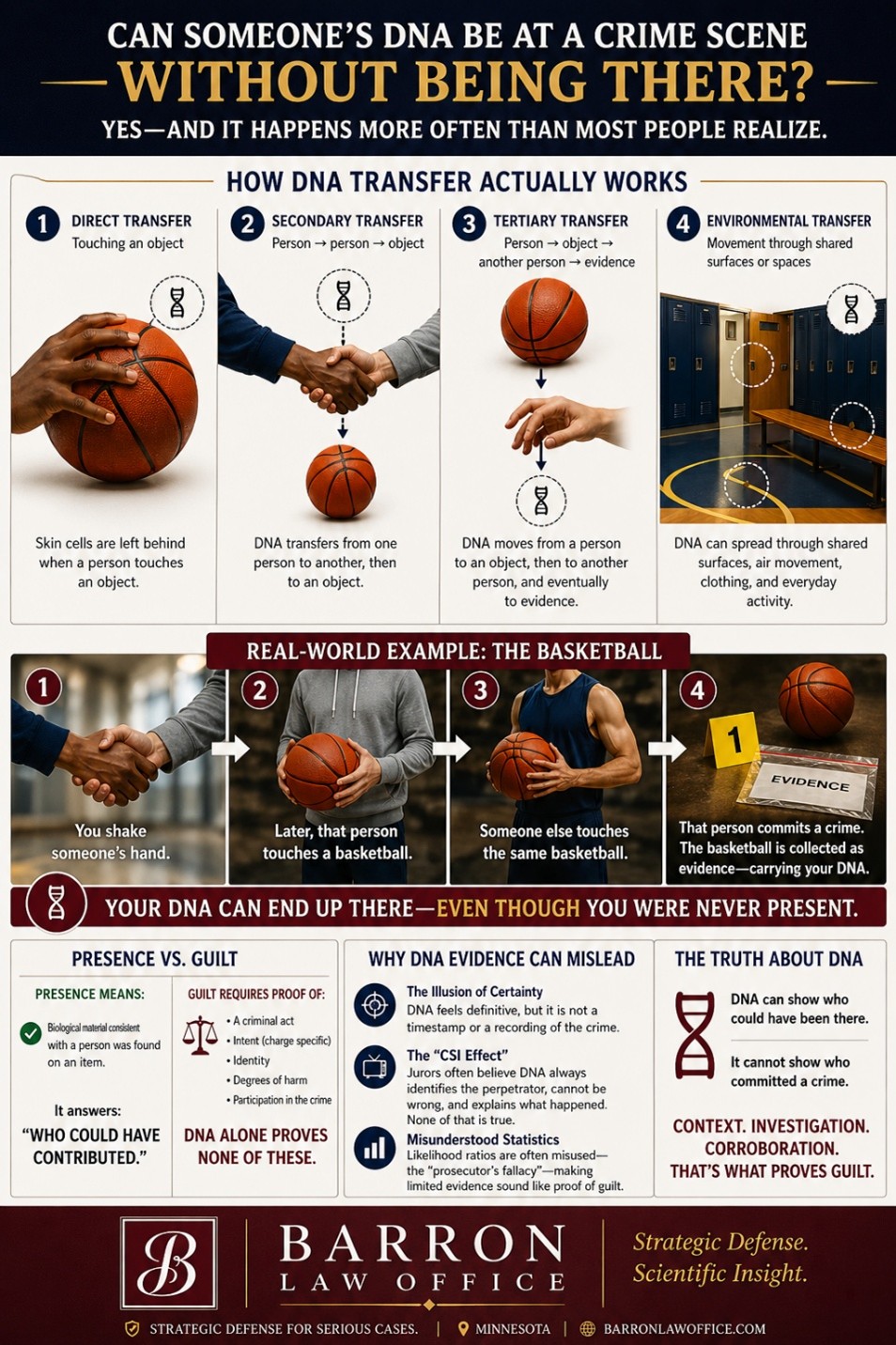
How DNA Transfer Actually Works
- Direct transfer: Touching an object
- Secondary transfer: Person → person → object
- Tertiary transfer: Person → object → another person → evidence
- Environmental transfer: Movement through shared surfaces or spaces
Example:
You shake someone’s hand.
That person later touches an object at a crime scene.
Your DNA can end up there—even though you were never present.
Why DNA Evidence Is So Convincing—And So Misleading
The Illusion of Certainty
DNA feels definitive. In Minnesota courts, DNA evidence is often presented with a level of certainty that exceeds what the science actually supports.
But it is not a timestamp or a recording of the crime.
DNA answers “who could have contributed”—not “who committed the crime.”
The “CSI Effect”
Jurors are conditioned to believe:
- DNA always identifies the perpetrator
- DNA cannot be wrong
- DNA explains what happened
None of this reflects real forensic science.
Misunderstood Statistics
The likelihood ratio is one of the most misunderstood concepts in forensic DNA analysis.
It does not tell us how likely it is that a person is the source of the DNA or that they committed a crime.
Instead, it compares how well the evidence fits between two competing explanations.
This misunderstanding often leads to the prosecutor’s fallacy (also known as the transposed conditional), where the statistic is incorrectly reframed as proof of guilt.
When that happens, a limited comparison is presented as overwhelming evidence — something it was never designed to be.
Real-World Scenarios Where DNA Evidence Misleads
The Bar Bottle
A bottle used in an assault contains a defendant’s DNA.
Prosecution: He used the weapon.
Reality: He handled it earlier in a crowded setting.
DNA in this scenario shows contact—not timing.
The Retail Transfer Case
A person briefly handles merchandise in a store.
Days later, it’s linked to a burglary—and their DNA is found.
DNA got there because of normal shopping—not criminal conduct.
The Borrowed Vehicle
DNA is found inside a vehicle used in a robbery.
Reality: The person had lawful access to the vehicle earlier.
DNA persists long after presence ends.
The First Responder Problem
Evidence is handled by multiple individuals before testing.
One had prior contact with the suspect.
DNA appears at the scene—but was carried there indirectly.
DNA can be introduced—not just left behind.
How Reliable Is DNA Evidence in Criminal Cases—and Can It Be Wrong?
DNA evidence can be reliable—but its interpretation is not always reliable.
It becomes weaker when:
- The sample is extremely small (touch DNA)
- Multiple contributors are involved (DNA mixtures)
- Analysts rely on assumptions
- Software interpretations are not challenged
- There is no timeline connecting DNA to the alleged crime
The critical question is not whether DNA exists—it is whether there is an explanation that makes sense.
Can DNA Evidence Be Wrong in Court?
Yes—especially in how it is interpreted.
DNA evidence leads to wrongful conclusions when:
- Transfer is ignored
- Context is missing
- Assumptions go unchallenged
- Investigations develop tunnel vision
A DNA match answers one question—and leaves the most important ones unanswered. In reality, DNA is just one investigative tool. Unfortunately, left unchallenged it can be used to create a false narrative.
What DNA Evidence Can and Cannot Prove
DNA can:
- Identify possible contributors
- Link biological material to an individual
DNA cannot:
- Prove when it was deposited
- Explain how it got there
- Establish intent or criminal conduct
The Legal Risk: When Presence Is Treated as Proof
When presence is mistaken for guilt, the consequences are severe:
- Wrongful convictions
- Pressure on defendants to explain DNA
- Investigations that stop too early
- Overreliance on complex forensic software
DNA should help inform a case—not decide it.
What an Experienced Defense Attorney Looks For
In Minnesota DNA cases, outcomes often turn on what is not explained.
At Barron Law Office, I look at the following:
- Type of DNA sample (touch, mixture, low-level)
- Transfer pathways
- Analyst assumptions
- Statistical interpretation
- Missing timelines
The issue is often not whether DNA is present—but whether the prosecution’s interpretation can withstand scrutiny.
Frequently Asked Questions About DNA Evidence
Does DNA prove guilt?
No. It only shows that biological material may be consistent with a person.
Can DNA be transferred without contact?
Yes. Through secondary or indirect transfer.
Can DNA show when it was deposited?
No. Current DNA testing cannot determine timing.
Is DNA evidence enough to convict someone?
No. It must be supported by other evidence. However, if left unchallenged, it can make the State’s case appear much stronger than it actually may be.
Can experts disagree on DNA results?
Yes. Interpretation involves judgment and assumptions. The literature I have read makes it clear that analysts at different labs can reach different conclusions. Also, analysts within the same lab can reach different conclusions on DNA evidence.
What is touch DNA?
Extremely small amounts of DNA, typically from epithelial cells (skin cells) or sweat transferred from a person to a surface.
The Bottom Line
DNA evidence is powerful—but it is not proof of guilt.
At best, DNA shows that contact may have occurred at some point in time. The law requires proof of conduct.
In DNA cases, the most dangerous evidence is not what is found—it’s what is assumed.
When that distinction is ignored, justice fails and innocent people can be wrongly convicted.
If DNA Evidence Is Being Used Against You, Act Immediately
A DNA “match” can feel like the end of the case.
In reality, it is often where the defense begins.
Because the real issue is not whether DNA exists—
it is whether the prosecution can prove:
- When it was deposited
- How it got there
- Whether it actually connects to a crime
If those questions are unanswered, reasonable doubt exists.
Every day you wait, critical evidence can be lost, and the prosecution’s narrative can become harder to challenge.
Opportunities to challenge flawed DNA evidence early in a case are often lost permanently if action is delayed.
At Barron Law Office, I:
- Analyze raw forensic data—not just reports
- Challenge assumptions behind DNA conclusions
- Identify transfer explanations the state ignores
- Expose the gap between presence and proof
I don’t rely on the State’s narrative. I examine the evidence. Because what matters is not just what the evidence shows — but what it actually means.
Contact Barron Law Office today for a confidential consultation.