



And Why It Is Not Nearly as Certain as Prosecutors Claim
The prosecutor holds up the lab report and the room shifts. Jurors lean forward. Some stop questioning the evidence entirely. DNA was found, the prosecutor says, and in that moment many jurors assume the case is essentially solved. Prosecutors know it. Investigators know it. Television has trained the public to believe it. What those jurors do not hear is that the DNA may have arrived through indirect transfer, that the sample may contain multiple contributors whose identities are genuinely uncertain, or that the analyst made subjective interpretation decisions hidden beneath statistical language that sounds far more certain than the science actually supports.
DNA is not a magical truth machine. It is biological material collected, processed, interpreted, and explained by human beings, and at every stage of that process, mistakes, assumptions, contamination risks, and misleading conclusions can enter the case.
The core problem in many DNA cases is not whether the DNA exists. It is whether the conclusions presented to the jury accurately reflect the limits of that science.
In Minnesota courtrooms, the science itself may be valid while the presentation of that science can become dangerously overstated.
How DNA Evidence Enters a Minnesota Criminal Case
DNA does not walk into a courtroom on its own. It travels a long, human-handled road, and every step of that road is an opportunity for error, contamination, or misinterpretation. DNA evidence typically enters a Minnesota criminal prosecution through one of three primary pathways.
1. Crime Scene Collection
Law enforcement or forensic technicians recover biological material from the scene of an alleged crime: blood, saliva, semen, skin cells, hair roots, clothing, firearms, vehicles, door handles, cell phones, or other physical objects. That material is packaged, logged into a chain of custody, and transported to a forensic laboratory for analysis. The conditions under which it is collected, packaged, and stored directly affect whether the resulting profile is reliable.
2. CODIS Database Comparison
Minnesota participates in CODIS, the FBI’s Combined DNA Index System. If crime scene DNA is uploaded and a profile is found in the database, typically from a prior conviction or arrest, investigators receive a hit that names a potential suspect without any other physical evidence connecting them to the scene. These are often called cold hit cases. Once a database result occurs, all subsequent investigation is frequently shaped by that starting point, creating confirmation bias that can distort the entire case.
3. Direct Suspect Comparison
Once police have a person of interest, they obtain a reference sample through consent, a search warrant, or a court order, and send it to the lab for comparison against the crime scene sample. But even when profiles appear consistent, that does not automatically establish when the DNA was deposited, how it arrived, whether the transfer was innocent, or whether the suspect committed the alleged offense.
A critical but rarely discussed concept underlying all three pathways is the chain of custody: the documented, unbroken sequence of people and locations that handled the evidence from collection through trial. Any gap, irregularity, or undocumented transfer in the chain is grounds for challenging whether the evidence was compromised before it ever reached the lab.
From Sample to Courtroom: How DNA Testing Actually Works
Understanding what happens between sample collection and expert testimony helps provide a better understanding of where things can go wrong. DNA testing is not a single step. It is a sequence of laboratory procedures and interpretation decisions, each stage with its own failure points.
1. Sample Preservation and Intake
DNA degrades. Heat, moisture, sunlight, and microbial activity all destroy biological material. Evidence must be packaged in breathable containers, kept at appropriate temperatures, and transported promptly. Samples that arrive at the lab compromised or degraded produce profiles that are harder to interpret and more susceptible to error. That fact is rarely disclosed in a DNA report’s conclusions.
2. Extraction and Quantification
Lab technicians first extract DNA from the biological material, then measure how much usable DNA is present. Low-template samples, typically anything below roughly 100 to 200 picograms of DNA, significantly increase the chance of a partial or ambiguous profile. Quantification results should be documented in the case file and requested in discovery.
3. STR Typing
The industry standard for forensic DNA analysis is Short Tandem Repeat (STR) typing. STRs are specific locations in the genome where a short DNA sequence repeats a variable number of times. Different people carry different numbers of repeats at each location. At each locus, a person has two alleles, one from each parent. A forensic DNA profile is a list of those allele numbers across all tested loci.
4. PCR Amplification
Because biological samples recovered from crime scenes often contain very small amounts of DNA, the lab uses polymerase chain reaction (PCR) to amplify the DNA before analysis. PCR is powerful, but it also amplifies contaminants and introduces artifacts. The amplification process is where stutter peaks, drop-in, and drop-out events originate.
5. Electrophoresis and the Electropherogram
After amplification, DNA fragments are separated by size using capillary electrophoresis and detected as peaks on a graph called an electropherogram. Each peak corresponds to an allele at a specific locus. The height of a peak reflects the quantity of that DNA. Analysts interpret these peaks to generate the DNA profile, deciding which peaks are true alleles and which are artifacts. That interpretive step is where human judgment enters the process, and where the results become vulnerable to challenge.
It doesn’t get fixed in the lab. It gets interpreted.
6. Probabilistic Genotyping and STRmix Interpretation
Once the electropherogram is generated, the analyst still must determine what the profile means, particularly when the sample contains DNA from multiple contributors. In many modern Minnesota cases, that interpretation is performed using probabilistic genotyping software such as STRmix.
Probabilistic genotyping software was introduced to bring mathematical rigor to the subjective process of mixture interpretation. It uses Markov Chain Monte Carlo simulation to search through millions of possible genotype combinations and estimate which best explain the observed data.
STRmix does not function as a machine that simply announces whether a suspect’s DNA is present. It is a statistical modeling system that evaluates millions of possible genotype combinations to determine how strongly the observed DNA data supports one interpretation over another. The software attempts to account for complex variables including contributor number, peak height variation, stutter artifacts, allelic dropout, degradation, and low-level DNA.
In simple terms, STRmix is not asking, “Is this person’s DNA present?” It is asking, “How well does the observed DNA data fit the proposition that this person contributed to the mixture compared to the proposition that an unknown, unrelated person contributed instead?”
To produce a result, the analyst must make a series of input decisions and assumptions before the software is ever run. These include estimating the number of contributors, setting interpretation thresholds, selecting analytical parameters, and determining how the software should account for artifacts and dropout probabilities. The resulting statistical conclusion depends heavily on those assumptions.
The software then generates a Likelihood Ratio: a statistical comparison of how much more probable the DNA evidence is if the suspect contributed to the sample versus if an unknown, unrelated person contributed instead. Those numbers are often presented to juries using phrases such as “strong support” or “extremely strong support,” language that can sound far more definitive than the underlying science justifies.
Probabilistic genotyping can be a useful forensic tool. But it does not eliminate human judgment from DNA interpretation.
7. Report Generation
The final DNA report is a summary of the analyst’s conclusions. It is not the raw data. It is one person’s interpretation of the raw data. The electropherogram files, case notes, and quality control records underlying that report are the actual evidence, and they are almost never provided to the defense without a specific discovery request.
DNA Mixtures: Where Modern DNA Litigation Becomes Extremely Complex
The public often imagines DNA evidence as a clean, single-source sample. In reality, most modern forensic DNA cases involve mixtures.
A DNA mixture contains genetic material from two or more individuals. Mixtures arise constantly in real-world scenarios: multiple people touching the same object, sexual assault cases involving multiple contributors, crime scenes where victim and suspect biological material intermingles, or environmental contamination of a sample. Firearms, steering wheels, clothing, cell phones, household items, and shared living spaces are among the most common sources.
Mixture interpretation requires analysts to determine how many contributors are present, which alleles belong to which contributor, whether artifacts are present, and whether a specific person can reliably be included. This process becomes especially difficult when DNA levels are low, samples are degraded, contributors overlap genetically, or multiple people handled the same object.
When a mixture contains three or more contributors, the number of possible genotype combinations becomes enormous. An analyst asking whether a suspect’s profile is consistent with the mixture is asking: of all the possible ways these alleles could be divided among contributors, does any combination include this person’s profile? For many suspects, especially those with common alleles, the answer will be yes, even if they had no connection to the crime.
Allelic Dropout and Drop-In
Low-level DNA mixtures create additional interpretation problems. Allelic dropout occurs when a true genetic marker fails to amplify and appear in the profile, causing the analyst to undercount a contributor’s alleles. Drop-in occurs when a stray allele appears from contamination or artifact. Both phenomena are more likely in degraded or low-template samples, and both can cause an analyst to incorrectly include or exclude a contributor.
The DNA Analyst Is Not Reading a Machine Output
Jurors often assume the laboratory analyst is simply reporting a machine-generated answer. That assumption is incorrect and consequential.
The DNA analyst is an interpreter, making consequential judgment calls at every stage of the process that the final report almost never discloses. Critical decisions made by analysts include deciding how to handle stutter peaks that appear near true alleles and can be misread as additional contributors, calling results inconclusive, and, most significantly in complex cases, determining how many contributors are present in a mixture and which alleles belong to which contributor.
These decisions are not algorithmic. They involve professional judgment applied to ambiguous data. Labs have written protocols, but those protocols allow interpretive latitude. Research has repeatedly demonstrated that different analysts examining the same evidence can reach materially different conclusions, including conclusions that would, in actual cases, either implicate or exonerate the same defendant. This is the scientific reality underlying DNA mixture samples, and juries are almost never told about it.
Analysts are also not independent of the investigation. In Minnesota, as in most states, crime labs operate under the authority of law enforcement agencies. Most analysts are employees of institutions whose institutional mission is to support prosecution. While individual analysts may strive for objectivity, forensic science research has documented that contextual information, knowing a suspect has been identified, that a detective urgently needs a result, or that charges have already been filed, can unconsciously influence interpretation. While this is a documented feature of human cognition, and not an actual form of misconduct, the end result can still be the same.
The Likelihood Ratio Does Not Answer the Question of Whether a Person is Actually in the Mixture
A Likelihood Ratio of one billion does not mean there is a one-in-a-billion chance the defendant is innocent. It means the DNA evidence is one billion times more probable under the hypothesis that the suspect contributed to the sample than under the hypothesis that an unknown person contributed instead. The number sounds like certainty. It is not. It does not answer the actual question jurors want to know because it does not establish that a person truly contributed to the mixture.
What DNA Evidence Cannot Tell a Jury
Timing
The testing lab analysts perform does not tell a person when the DNA was deposited. A profile recovered from a crime scene could reflect presence from days, weeks, or months before the alleged crime. There is no forensic method for determining, from the DNA itself, when biological material was left at a location.
Transfer and Origin
DNA is like glitter. It spreads easily, transfers unexpectedly, and once it is on an object, it is very difficult to determine how it arrived. The testing lab analysts perform tells us nothing about how DNA got onto an item of evidence. DNA can transfer directly, indirectly, or through secondary contact. A person’s DNA may appear on an object they never touched, carried there through another person or object.
Criminal Conduct
DNA at a scene establishes possible biological presence. It does not automatically establish who deposited the DNA, when it was deposited, how it arrived there, or whether the contact was criminal. DNA may show possible biological association. It does not by itself establish intent, consent, or what actually happened.
The Meaning of Absence
Courts and jurors sometimes assume that the absence of a suspect’s DNA is exculpatory. DNA is not always deposited, not always collected, and not always preserved. Absence of DNA evidence is absence of evidence. It is not evidence of absence.
DNA can answer the question: “Whose biology may be present?” It often cannot answer the far more important courtroom question: “What actually happened?”
How Prosecutors Present DNA Evidence
Prosecutors have developed a reliable toolkit for maximizing the persuasive impact of DNA evidence. Understanding these tactics is the foundation of an effective defense.
The Statistical Anchor
Prosecutors lead with the Random Match Probability or Likelihood Ratio before the jury has heard a single word about how that number was generated. The figure creates an anchoring effect: every subsequent piece of evidence is evaluated against the presumption of guilt that number establishes. What prosecutors rarely explain is the population genetics model used, the subpopulation database selected, or the statistical assumptions underlying the calculation.
The Prosecutor’s Fallacy
One of the most dangerous errors in DNA litigation is the Transposed Conditional, also called the Prosecutor’s Fallacy. It occurs when someone confuses “the probability of the evidence given the propositions” with “the probability of the propositions given the evidence.”
A simple example illustrates the problem:
“The probability that an animal has four legs if it is an elephant” does not mean the same thing as “the probability that an animal is an elephant if it has four legs.”
The second statement is false because cows, horses, dogs, cats, and many other animals also have four legs. Reversing the conditional changes the meaning entirely.
The same problem appears in DNA evidence.
For example, a statement such as:
“The DNA results are greater than 100 billion times more likely to have come from Person X than anyone else”
transposes the conditional because it shifts the focus from the probability of observing the evidence under competing propositions to the proposition itself.
A more scientifically accurate way to express the result would be:
“The DNA results are greater than 100 billion times more likely to be observed if the evidence came from Person X than if the evidence came from an unknown, unrelated individual.”
The word “if” matters because the statement is conditional. The statistic describes the probability of observing the DNA evidence under particular assumptions. It does not directly measure the probability that the underlying proposition is true.
This distinction is technically complex and frequently misunderstood. Judges, jurors, attorneys, and even forensic analysts confuse these concepts in Minnesota courtrooms regularly.
“Cannot Be Excluded” Framing
In mixture cases, “the defendant cannot be excluded” sounds uniquely incriminating. In many mixture scenarios, a substantial percentage of the general population would also not be excluded from the same evidence. Prosecutors do not volunteer that information. Defense attorneys must surface it.
Linking DNA to the Act
Perhaps the most consequential prosecution tactic is presenting DNA evidence as though it proves the defendant committed the crime, when all it establishes is that their biological material may have been present. These are entirely different propositions. Courts frequently permit this conflation in closing arguments, and defense attorneys must be prepared to address it directly.
What This Looks Like in a Real Case
In one Minnesota case I reviewed, the DNA evidence against the defendant appeared straightforward on the face of the lab report. The prosecution had a statistical conclusion. The language in the report implied the defendant was a possible contributor to a DNA mixture found on a firearm. What the report did not say was that the actual Likelihood Ratio in the underlying file was 0.532.
A Likelihood Ratio below 1 is exclusionary. It means the DNA evidence is more consistent with the suspect not being a contributor than with the suspect being one. The reciprocal of 0.532 is approximately 1.88, meaning the evidence was nearly twice as likely if the defendant did not contribute than if he did. Two of the four individual population databases returned results that were even more strongly exclusionary. The BCA’s own file contained a number that pointed away from the defendant. The report characterized it as “equally likely either way.” Those are not the same thing, and the difference would never have been discovered without reading the underlying data.
In the companion case for the same defendant, the problem ran deeper still. When the DNA profile the lab attributed to him was compared across the two case files, the profiles were completely different genetic profiles. They could not both belong to the same person. The profile being used against him in one case was, upon examination, the profile of a co-defendant. The profiles had been swapped. The lab had issued reports in both cases, drawn inclusion and exclusion conclusions, and calculated likelihood ratios, all built on the wrong genetic foundations.
Neither finding appeared in any summary report. Both were found in the underlying data when I read the files.
For Defendants: What You Need to Know
If DNA evidence is being used against you, it does not automatically mean you were at the scene, that you committed the crime, or that the evidence against you is reliable. It means your case needs to be examined, carefully, thoroughly, and starting from the beginning.
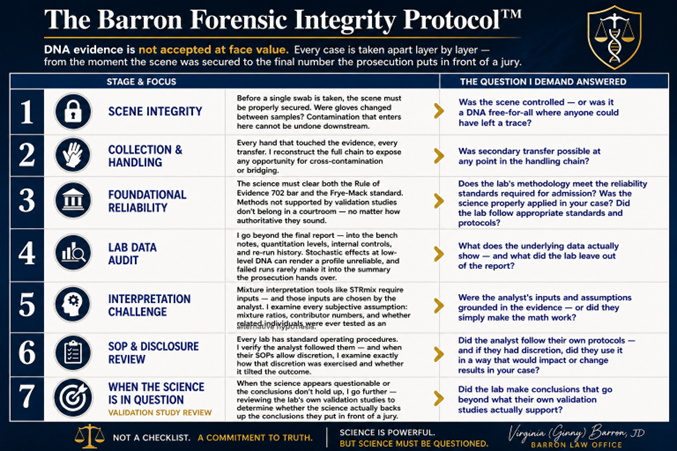
The lab report the prosecution will use against you is a summary. It tells you what the lab concluded. It does not tell you how the evidence was collected, whether gloves were changed between items at the crime scene, whether the scene was properly secured, whether the DNA could have been transferred to that item by someone other than you, or whether the statistical conclusion would survive scrutiny if anyone examined the assumptions behind it. Those details are not in the report. They are in the collection documentation, the chain of custody records, the bench notes, the underlying lab data files, and they require someone who knows what to look for.
Here is what many defendants never learn until too late:
- DNA evidence can be scientifically valid in general and still be wrong in your specific case.
- A statistical conclusion does not tell you when the DNA was deposited, how it got there, or whether it has any connection to the alleged crime.
- DNA can transfer indirectly. Your biological material can appear on an object you never touched, carried there by another person or through shared contact with a surface.
- The analyst made judgment calls that may have affected the conclusion, and those calls are almost never disclosed in the summary report.
- Small changes in software assumptions can produce dramatically different statistical outcomes from the same raw data.
- If the same sample were tested again by a different analyst, the result could look entirely different.
In cases I have reviewed, I have found results that fell apart when the underlying data was examined against the lab’s own standard operating procedures. A profile on a firearm that could have come from contact with clothing rather than the person who allegedly used it. DNA on a surface consistent with presence long before the alleged crime. Results reported as inclusions that shifted substantially when re-examined under different, equally defensible assumptions.
None of that appeared in the summary report. All of it can change the direction of a case.
If DNA evidence is being used against you in Minnesota, you are entitled to have that evidence reviewed at the data level, not just at the report level. The question is not only what the DNA shows. It is whether that DNA means what the prosecution says it means. For a broader overview of that defense work, visit the main DNA page.
Every case is fact-specific. This is not legal advice. You need a case-specific consultation.
Call or text Ginny Barron directly at 507-822-5735, or submit a case review request at vbarronlawoffice.com. When you contact Barron Law Office, you work directly with Ginny, not a case manager, not a paralegal. One-on-one representation from the first contact forward.
For Defense Attorneys: What You Need to Know
If you are handling a case with DNA evidence and have not examined the underlying lab file at the data level, the gap between what the report says and what the data actually shows is where your client’s case is most at risk.
DNA cases are not won or lost on general legal arguments about forensic evidence. They are won or lost at the data level. The summary report the prosecution discloses tells you what the lab concluded. It does not tell you whether the quantitation data supported interpretation at all, whether assumptions or conclusions were changed during the technical review process, what impact different analytical inputs would have had on the final conclusion, or whether the lab’s own validation studies actually support the result in the report. Those details can only be found in the bench notes and underlying lab file, and they require someone who knows what to look for and what it means when they find it.
In cases I have reviewed through this practice, the underlying lab data has produced findings that did not appear anywhere in the summary report: software run on samples that exceeded the parameters of the lab’s own validation studies, producing likelihood ratios the lab had no empirical basis to claim were reliable. Likelihood ratios reported in language that obscured the fact that the number was exclusionary, not inclusionary. A DNA profile attributed to one defendant that, on examination of the underlying file, was actually the profile of a co-defendant. Analyst interpretation decisions applied inconsistently within the same processing batch, with no documented scientific basis for the different treatment. Interpretation decisions about major profiles have been applied in ways the lab’s own standard operating procedure does not support. Contamination detected in negative controls processed alongside evidence samples, where the allele that appeared in the contaminated control was one shared by the defendant. None of those findings were visible from the summary report. Every one of them changed the direction of the case. The defense that finds those problems is the defense that has read the file. The difference between a conviction and an acquittal is often exactly that.
Barron Law Office provides forensic DNA case review for defense attorneys throughout Minnesota. That review includes written analysis of the underlying data, identification of the specific points where the evidence may be vulnerable, and a litigation strategy framework built around what the data actually shows, not just what the report says. The analysis provided is a case-specific assessment of whether the result the prosecution is relying on can withstand scrutiny.
Co-counsel arrangements are available in cases where the forensic issues are complex enough to require courtroom support. Consulting arrangements are also available where you need the analysis but want to handle the litigation yourself. Either way, what Barron Law Office provides is grounded in the same standards the lab is supposed to be following, including familiarity with lab practices, STRmix, FBI Quality Assurance Standards, ANSI/ASB forensic standards, and SWGDAM guidelines.
If the evidence in your client’s case has a problem, the time to find it is before trial, not during cross-examination.
Call or text 507-822-5735, or submit a case inquiry at vbarronlawoffice.com.
Frequently Asked Questions About DNA Evidence in Minnesota Criminal Cases
If my DNA was found at the scene, does that mean I will be convicted?
No. A DNA statistical conclusion may suggest biological presence, but it does not automatically prove guilt. DNA testing the lab performs cannot determine when it was deposited, how it got there, or whether the contact was innocent or unrelated to the alleged crime. Many DNA cases involve transfer, contamination, or interpretation issues that are never disclosed in the summary report.
Can DNA evidence be wrong?
Yes, in multiple distinct ways. The profile itself may be contaminated or degraded. The interpretation of a mixed-source profile involves subjective analyst decisions that research has shown vary between analysts given the same data. The statistical presentation depends on assumptions that may not hold for the specific sample or population at issue. And the conclusions drawn from those statistics are frequently overstated in court testimony. DNA evidence is powerful but it is not infallible.
Can someone’s DNA appear somewhere even if they never committed a crime?
Yes. Secondary transfer, the movement of biological material through an intermediary object or person, occurs across a wide range of case types and evidence items. The presence of a person’s DNA on any object does not establish how it arrived there.
What does it mean when the analyst says I “cannot be excluded”?
It means your DNA profile may be consistent with the evidence. It does not mean you were a contributor, that you were present during a crime, or that you committed the offense. In complex mixtures, a substantial percentage of the general population could also not be excluded from the same evidence. That information is almost never volunteered by the prosecution or the lab analyst. A qualified forensic defense attorney should ask the analyst to quantify precisely how many people in the relevant population would meet the same threshold. That answer frequently makes the finding far less incriminating than it sounds in the courtroom.
What is a DNA mixture and why does it make a case more complex?
A DNA mixture contains genetic material from two or more people. Interpreting it requires the analyst to determine how many contributors are present, which alleles belong to whom, and whether a specific person is a contributor, without being able to see individual genotypes directly. These are subjective determinations. Research has repeatedly shown that different analysts given the same mixture evidence reach materially different conclusions.
What is a Likelihood Ratio?
A Likelihood Ratio is the number generated by probabilistic genotyping software to express how much more probable the DNA evidence is if the suspect contributed to it, compared to a random, unrelated person. That number can sound like certainty. It is not. It describes the probability of the evidence under competing assumptions. It does not establish that the suspect was present or that a crime occurred.
Is STRmix always reliable?
No. Reliability depends on proper laboratory validation for the specific sample type, accurate analyst inputs, correct contributor estimates, and appropriate interpretation procedures. STRmix generates results based on assumptions the analyst selects. Small changes in those assumptions can shift the Likelihood Ratio substantially.
Can DNA evidence be challenged or excluded in Minnesota?
Yes. Minnesota Rule of Evidence 702 requires that expert testimony be supported by foundational reliability. The Frye-Mack standard requires that the scientific method be generally accepted in the relevant field. Even a widely accepted testing method can be challenged if the lab did not follow appropriate standards and protocols in your specific case. Defense attorneys may seek to limit or exclude DNA evidence when the foundational requirements have not been met.
Why is forensic DNA experience important in criminal defense?
DNA litigation involves complex scientific interpretation, software modeling, statistical analysis, and expert witness cross-examination that requires understanding the evidence at the data level, not just the legal level. An attorney who understands what an electropherogram shows, what the difference between a Combined Probability of Inclusion and a Likelihood Ratio means, how STRmix assumptions affect results, and where the Prosecutor’s Fallacy appears in testimony can find opportunities that an attorney who accepts the lab report at face value will not.
Facing DNA Evidence in Minnesota? Early Forensic Review Matters.
DNA evidence cases should never be treated as routine criminal defense matters. The most important evidence in a DNA case is often not the final laboratory report. It is what is buried in the raw data, the assumptions, and the interpretation decisions behind that report.
Early forensic review can identify weaknesses involving mixture interpretation, transfer evidence, contamination, probabilistic genotyping assumptions, analyst subjectivity, and overstated statistical conclusions, before the prosecution’s narrative becomes locked in.
Virginia “Ginny” Barron is a Minnesota criminal defense attorney with over twenty years of legal experience and more than a decade focused on forensic DNA litigation. She holds the same STRmix training as the lab analysts who produce the reports used against defendants. She is a Fellow of the American Academy of Forensic Sciences and has served in leadership roles in the AAFS Jurisprudence Section. She has presented at national AAFS conferences on DNA interpretation standards, trained Minnesota public defenders statewide on DNA litigation, and litigated complex DNA cases involving STRmix, mixture profiles, touch DNA, and disputed forensic interpretation throughout Minnesota.
When the prosecution relies heavily on forensic evidence, the defense must understand both the law and the science behind the conclusions presented to the jury.
Call or text Ginny Barron directly: 507-822-5735
Submit a form at vbarronlawoffice.com
You reach Ginny directly. This is personal, one-on-one representation from the first contact forward.
This content is for informational purposes only and does not constitute legal advice. Every case is fact-specific. Contact Barron Law Office for a case-specific consultation.