

The Critical Truth That Can Decide Your Freedom
You can be charged with assault, even if the only evidence against you is your DNA.
And in many cases, that evidence does not prove a crime happened at all.
That is not a loophole.
That is the law.
But in courtrooms across Minnesota, juries are often led to believe something very different.
They are led to believe that a DNA match equals guilt.
It doesn’t.
It cannot explain what happened.
And it cannot prove what you intended.
And in an assault case, intent is what determines whether you walk free—or lose everything.
People are convicted every year based on DNA evidence that never proved a crime occurred.
When DNA is misunderstood, it doesn’t just confuse a case, it can change someone’s life permanently.
What Does DNA Evidence Actually Prove in an Assault Case?
Short answer: far less than most people think.
DNA evidence can:
- Show that biological material is present
- Suggest that contact may have occurred
- Include or exclude possible contributors
DNA evidence cannot:
- Prove intent
- Determine when contact occurred
- Distinguish consent from force
- Explain what happened during an interaction
DNA answers one limited question: who may have contributed to the biological material present.
It does not answer the questions that decide guilt.
Think of it this way:
DNA can show who may have contributed to the biological material present.
It does not establish how or when it was deposited or what it means.
Does DNA Evidence Prove Assault?
No. DNA evidence does not prove assault.
It may show that biological material is present or that contact may have occurred, but it cannot prove intent, timing, or whether the contact was criminal.
The Legal Standard in Minnesota Assault Cases
In Minnesota assault cases, the prosecution must prove:
- An act (physical contact or alleged harm)
- Intent (a deliberate purpose to cause harm or fear)
Both must be proven beyond a reasonable doubt.
DNA may relate to the first.
It cannot prove the second.
There is no forensic test for intent.
No lab result can measure a state of mind.
Why DNA Evidence Feels More Powerful Than It Is
DNA carries psychological weight.
To jurors, it feels:
- Scientific
- Objective
- Certain
But that perception creates a dangerous shortcut:
“If the DNA matches, the case is proven.”
That belief is not just incorrect—it is risky.
DNA evidence can be scientifically accurate—and still legally misleading.
The Biological Fallacy: Contact Is Not Assault
Modern DNA testing is extremely sensitive.
It can detect genetic material from just a few skin cells.
That creates a critical legal problem:
DNA can confirm contact—but it cannot define the nature of that contact.
Contact may be:
- Innocent
- Accidental
- Consensual
- Indirect
The law does not punish contact.
It punishes intentional conduct.
When DNA Looks Damaging—but Isn’t
In one Minnesota assault case, a client was accused after DNA was found on a jacket worn by the alleged victim.
On paper, the case looked strong:
- A reported incident
- A DNA “match”
- A prosecution narrative built around that match
But the context told a different story.
The individuals:
- Lived in the same residence
- Shared common areas
- Had routine, everyday contact
The DNA sample was not a clean profile—it was a mixture involving multiple contributors.
Once that context was uncovered, the meaning of the DNA changed entirely.
What appeared to be evidence of assault became evidence of ordinary human interaction. The scientific literature is clear that we expect to find a person’s DNA all over the areas in which they live.
This is where cases are decided:
not by the presence of DNA—but by whether its meaning is challenged.
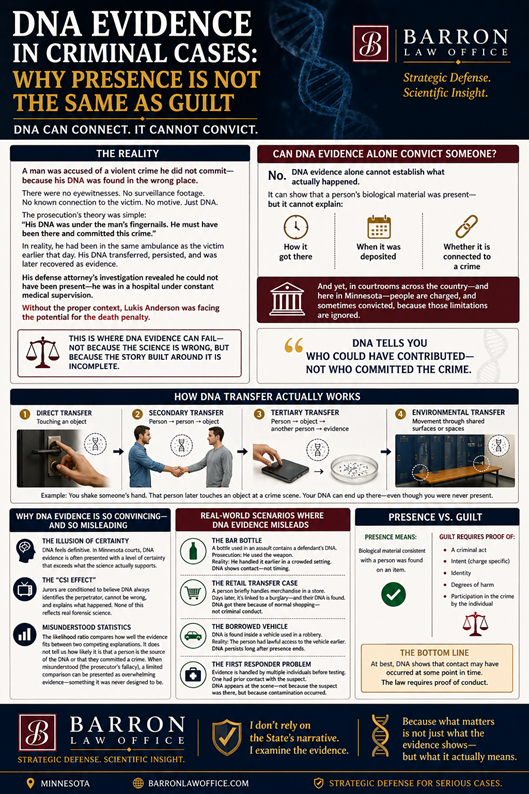
Can Your DNA Be Found Somewhere You’ve Never Been?
Yes.
This is called secondary transfer.
Your DNA can move through:
- Other people
- Shared objects
- Everyday environments
DNA can travel without you.
This means:
- A DNA match does not always prove presence
- And it never proves intent
Learn more here: The Problems With Touch DNA and Low-Template DNA in Criminal Cases. Here is a visual that helps explain this:
Can DNA Show When Something Happened?
No.
DNA has no reliable timestamp.
It can remain:
- Minutes
- Hours
- Days
- Months
- Sometimes even years
Timing is one of the biggest weaknesses in DNA evidence—and one of the least understood by juries.
What If the DNA Evidence Is Strong?
This is where many people get stuck.
“What if the DNA is a clear match?”
Even then:
- It may identify a person—but not their intent
- It cannot distinguish consent from force
- It cannot determine when contact occurred
- It cannot explain what happened
Even strong DNA evidence does not prove an assault occurred.
The Technology Problem: When Software Shapes the Conclusion
In many Minnesota forensic labs, DNA mixtures are analyzed using probabilistic genotyping software.
These systems:
- Depend on assumptions
- Require human input
- Produce statistical probabilities—not certainty
If the assumptions are flawed, the results can be misleading.
At that point, the “science” becomes interpretation—not fact.
The Human Factor: Contextual and Confirmation Bias
DNA analysis is not performed in a vacuum. Analysts are often exposed—directly or indirectly—to case information, such as investigative details or expectations about a suspect. This exposure creates the risk of contextual bias.
Contextual bias occurs when outside information influences how evidence is interpreted. Even subtle details—like knowing a suspect has confessed or that other evidence points in a certain direction—can shape how an analyst views the data.
Closely related is confirmation bias—the tendency to favor interpretations that align with an existing belief or expectation. Once a narrative begins to form, ambiguous or borderline results may be interpreted in a way that supports that narrative rather than challenges it.
Together, these biases can affect:
- How ambiguous DNA data is interpreted
- Decisions to include or exclude a potential contributor
- The weight given to certain findings over others
- The conclusions ultimately reported
These influences are often unintentional, but their impact can be significant.
Forensic evidence may appear objective, but it is still filtered through human judgment—and that judgment can be shaped by context and expectation.
Why Assault Cases Are Especially Vulnerable
Many Minnesota assault cases involve:
- People who know each other
- Prior contact
- Shared environments and living spaces
In these situations:
DNA presence is expected.
And when presence is expected:
It adds very little to the question that matters most—intent.
How DNA Evidence Is Challenged in Minnesota Courts
A strong defense does not attack DNA—it defines its limits.
A proper legal analysis asks:
- Where did the DNA originate?
- Could it have been transferred?
- When could it have it deposited?
- What is the context?
- Does it prove anything legally relevant?
This is how you start to build a narrative that can attack the State’s theory. For a broader overview of how Barron Law Office approaches forensic issues, see the firm’s main DNA defense page.
The 5-Part DNA Reality Framework
At Barron Law Office, DNA evidence is evaluated through a structured lens:
- Presence – Is DNA actually there?
- Transfer – How could it have gotten there?
- Timing – When could it have been deposited?
- Context – What relationship or scenario could explain the testing results?
- Intent Gap – What critical legal element is still missing?
If DNA cannot bridge the “intent gap,” it cannot prove an assault.
Frequently Asked Questions
Can you be convicted of assault based only on DNA evidence in Minnesota?
No. DNA alone does not prove intent, which is required for conviction under Minnesota law.
What does DNA evidence actually prove in court?
It can show biological presence and possible contact, but not intent, timing, or context.
Can DNA evidence be wrong in assault cases?
Yes. It can be misinterpreted, indirectly transferred, or taken out of context.
Does a DNA match mean a crime occurred?
No. It only suggests that genetic material may be present.
Can DNA prove non-consensual contact?
No. It cannot distinguish between consensual and non-consensual interactions.
Can someone be falsely accused because of DNA evidence?
Yes. DNA can be transferred indirectly or misinterpreted, leading to incorrect conclusions when context is ignored.
Why do prosecutors rely so heavily on DNA evidence?
Because juries tend to trust scientific evidence—even when its limitations are not fully explained.
Minnesota Assault Cases Involving DNA Evidence
In Minnesota, courts require proof beyond scientific association.
They require proof of intent beyond a reasonable doubt.
DNA can support a case.
It cannot replace the burden of proof.
Do Not Let DNA Evidence Define Your Case
DNA can put you in the story—but it cannot tell the story.
If you are facing a Minnesota assault charge involving DNA evidence, the biggest mistake you can make is assuming the evidence is conclusive.
It isn’t.
And waiting to challenge it can make your defense significantly harder.
DNA evidence is often presented with more certainty than the science actually supports—and once that narrative takes hold, it can shape the entire case.
At Barron Law Office, we do not accept DNA evidence at face value.
We:
- Break down how it was generated
- Challenge how it was interpreted
- Expose assumptions presented as conclusions
- Reframe the case around what the evidence actually proves
Because in many Minnesota cases, the outcome comes down to this:
Was the State’s theory of the DNA evidence properly challenged and were scientific limitations properly brought before the fact finder?
Speak With a Minnesota Defense Attorney Who Understands DNA Evidence
If your case involves DNA evidence, early decisions matter.
What you do now can affect everything that follows.
Most people wait too long to challenge DNA evidence—assuming it will “work itself out.”
By the time they act, critical opportunities are already gone.
The earlier DNA evidence is challenged, the more options you have. Waiting limits those options.
Schedule a Confidential Consultation Today
Contact Barron Law Office to evaluate your case and build a defense grounded in both forensic science and Minnesota law.
Final Truth
DNA can identify a person.
It cannot define their intent.
And in an assault case:
Intent is what determines whether you are convicted—or acquitted.