We Accept the Following Forms of Payment:
Minnesota Criminal Defense & Forensic Law Firm
Injustice Anywhere is a Threat to Justice Everywhere
Serving Southwest Minnesota


Forensic DNA evidenceis one of the most important scientific tools used in modern criminal investigations. DNA — short for deoxyribonucleic acid— is often described as a genetic blueprint because it contains the biological instructions that determine many of a person’s inherited characteristics. Nearly every cell in the human body carries the same DNA, whether it is found in blood, saliva, skin cells, or other biological material. This consistency allows scientists to collect biological material from a crime scene and compare it to a known sample from a person of interest. Because each individual’s DNA profile is highly unique (with the exception of identical twins), forensic testing can provide powerful information about whether a person’s genetic material is present in a particular location or on a particular object.
In criminal cases, DNA evidence can play a decisive role for both the prosecution and the defense. Prosecutors may use DNA results to suggest that a suspect is connected to biological material found at a scene, while defense attorneys must carefully examine how that evidence was collected, tested, interpreted, and presented. DNA does not automatically prove guilt; it only shows that genetic material is present. Understanding what DNA evidence can and cannot tell us is essential to ensuring that it is used fairly and accurately in court. For this reason, forensic DNA evidence is not just a scientific issue — it is a critical legal issue that can significantly influence the outcome of a criminal case.
DNA stands for deoxyribonucleic acid. It is the genetic material present in almost every cell of the human body and contains a unique profile for each individual (except identical twins). Humans share about 99.9% of the same DNA. There are, however, places on the human DNA molecule where humans can differ. Just like the English alphabet only has a limited number of letters to make up different letter combinations to form words; DNA also has a limited number of base pair combinations that can be used throughout all humans to create the human genetic markers. Typically speaking, with DNA we get half of our DNA from our mom and half of our DNA from our dad. Which means at each location we will typically have one genetic marker from mom and one genetic marker from dad.
For legal and forensic purposes, the idea is that biological specimens collected at a crime scene — for example blood, semen, saliva, skin cells — may contain DNA that can be compared to a suspect’s DNA sample. A person’s DNA is the same in blood, saliva, hair, semen, skin cells and other biological material. Biological material may be present at a crime scene even if it is not visible to the naked eye.
In the early years of forensic DNA testing, laboratories needed large, visible biological stains—such as blood or semen containing thousands of cells—to generate a usable DNA profile. The technology simply was not sensitive enough to work with tiny or invisible amounts of genetic material. Today, that has changed dramatically. Modern testing methods are so sensitive that analysts can often obtain a DNA profile from just a few skin cells left behind. This type of material, often called touch DNA, may be completely invisible and can be transferred through ordinary, everyday contact. While this advancement has expanded the ability of law enforcement to recover genetic material from crime scenes, it has also introduced new scientific and legal questions about how easily DNA can be deposited, moved, or transferred in ways that have nothing to do with criminal activity.
DNA is built from four chemical building blocks called bases: Cytosine (C), Guanine (G), Thymine (T), and Adenine (A). These bases do not exist randomly; they connect in very specific pairs known as base pairs. A base pair is formed when one base on one strand of DNA bonds with a matching base on the opposite strand, creating the “rungs” of the DNA ladder. The pairing rules are strict and consistent throughout all human DNA: Cytosine always pairs with Guanine, and Thymine always pairs with Adenine. This means the only possible pairings are C-G, G-C, T-A, and A-T. These predictable pairings are what allow DNA to form its famous double-helix structure and, more importantly for forensic science, allow scientists to read, copy, and compare specific regions of genetic material. It is the sequence—the order in which these base pairs appear along the DNA strand—that creates the unique genetic profile used in forensic identification.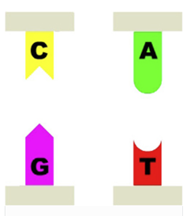
The unique characteristics that make each person biologically distinct are determined not just by the four DNA bases, but by the order in which those bases appear along the DNA strand. This order is called the DNA sequence. Even though all humans share the same four building blocks—C, G, T, and A—the sequence of these bases varies slightly from person to person. Those small differences in sequence are what allow forensic scientists to distinguish one individual’s DNA from another’s.
All of the DNA contained within a single cell is referred to as the genome. The human genome is extraordinarily large, consisting of approximately 3 billion base pairs organized into 23 pairs of chromosomes within the nucleus (plus a small amount of DNA from the mitochondria). If stretched out, the DNA from just one cell would measure several feet long, yet it is tightly packaged into a microscopic structure within the cell. Despite its size and complexity, only a very small portion of the genome is examined in forensic testing.
The physical structure of DNA is often compared to a ladder. The sides of the ladder are made of repeating chemical structures, while the rungs are formed by base pairs—C paired with G, and T paired with A. This ladder does not remain straight; instead, it twists upon itself in a spiral shape known as a double helix. This double-helix structure is what gives DNA both stability and the ability to be copied fairly accurately during testing.
Forensic scientists do not examine the entire genome when conducting DNA analysis. Instead, they focus on specific, well-known locations along the DNA strand called loci. Each locus contains a short sequence of base pairs that tends to vary significantly among individuals. These regions do not determine traits like eye color or height; rather, they are areas where natural variation occurs from person to person without affecting physical characteristics.
At each of these loci, a person inherits one genetic marker from their mother and one from their father. The combination of these markers at multiple loci creates a genetic profile. When forensic scientists compare DNA from a crime scene to a known sample, they are comparing these patterns across many loci to determine whether the sequences are consistent. The more loci that match, the stronger the statistical likelihood that the DNA originated from the same individual. This comparison of variations at multiple specific locations is the foundation of forensic identity testing. It is not the entire genome that matters for forensic purposes, but rather the distinct pattern created by differences in sequence at these targeted regions.
The 0.01% of DNA that is not the same between all humans is highly individualized. Single source DNA samples (DNA coming from only one person) have long been referred to as “the gold standard.” T.V. shows have sensationalized forensic testing leaving the general public with a belief that it is reliable and bulletproof.
Judges, jurors, and often lawyers do not understand the science behind DNA testing and put an unreasonable amount of faith in the interpretations made by labs who are run by state law enforcement agencies. However, despite its strength, DNA evidence is not infallible. In December 2024 the DNA Mixture Interpretation: A NIST Scientific Foundation Review was published by the National Institute of Standards and Technology, a division of the U.S. Department of Commerce, and states: All scientific methods have limits. :contentReference[oaicite:0]{index=0}
Understanding that all scientific methods have limits is essential to providing a full and fair defense in any case involving DNA evidence. Forensic testing is not magic; it is a human process carried out with instruments, protocols, assumptions, and interpretations that are subject to error, uncertainty, and judgment. Every step—collection, storage, testing, interpretation, and statistical reporting—carries some degree of risk that the result may be incomplete, misleading, or misunderstood. When courts and juries treat DNA results as infallible, they overlook the reality that the conclusions drawn from testing depend on the quality of the sample, the methods used, and the assumptions built into the analysis. In criminal cases, where a person’s freedom may depend on how that science is presented, a defense attorney must be able to identify and explain these limits so the evidence is evaluated in context rather than accepted at face value. Recognizing the boundaries of what DNA testing can and cannot reliably tell us is not an attack on science—it is a necessary step to ensure that scientific evidence is used responsibly, accurately, and fairly in decisions that affect life and liberty.
DNA was first introduced as evidence in 1986 in a case from Leicester, England. It ultimately led to the conviction of Colin Pitchfork for the death of two teenage girls. Tommie Lee Andrews became the first offender to be criminally convicted in the United States in 1987 with the use of DNA evidence. DNA was first used in a criminal case in Minnesota in the early 1990’s.
For prosecutors in Minnesota, the benefit of DNA evidence is obvious. A prosecutor will typically try to introduce DNA evidence to link a suspect to crime-scene biological material, especially in crimes such as sexual assault, homicide, or violent assault. But this may also include crimes like felon in possession, theft, or burglary. Because Minnesota law provides that the results of DNA analysis are admissible without antecedent expert testimony on general reliability (subject to the Rules of Evidence), it becomes imperative to have a defense attorney who knows how to raise an issue if there is concern with the reliability of testing in a particular case. :contentReference[oaicite:1]{index=1}
When handling cases in Minnesota courts that involve DNA evidence—the role of a defense attorney is multi-faceted:
In Minnesota, DNA testing itself has been found to be reliable and accepted by the general scientific community. Under Minnesota Statute, the analysis of those testing results are presumed to be admissible, unless challenged. What this means from a practical standpoint is that fighting DNA in a case will typically focus on the reliability of a particular test or conclusion made in your case rather than the general acceptance of DNA testing.
When DNA evidence is involved, the stakes are higher and the technical complexity increases. A defense attorney familiar with DNA issues in Minnesota courts can make a crucial difference. Here’s why:
If you or a loved one are facing charges in Minnesota where DNA evidence is in play, here are practical steps to consider:
While the basic statutes are in place, there are evolving issues in Minnesota DNA practice that a DNA defense attorney must watch:
Yes. While DNA testing is scientifically powerful, mistakes can occur in how evidence is collected, stored, tested, or interpreted. Contamination, secondary transfer, lab error, degraded samples, and complex mixtures can all affect the reliability of a result.
Secondary transfer happens when a person’s DNA is moved to an object or person without them ever touching it. For example, if you shake someone’s hand and they later touch an object, your DNA could end up on that object even though you were never there.
It does not automatically mean you committed a crime. DNA only shows that genetic material is present. It does not show when it got there, how it got there, or why it is there.
A mixture occurs when DNA from two or more people is found in a single sample. These are much more complicated to interpret and are often analyzed using probabilistic software like STRmix, which involves statistical modeling and assumptions.
STRmix is software used to interpret complex DNA mixtures. It does not “match” DNA. Instead, it produces a likelihood ratio based on statistical modeling. Understanding what that number really means is critical for a fair defense.
Minnesota law presumes DNA testing methods are reliable unless challenged by the defense. However, that does not mean the specific test in your case was done correctly or interpreted properly. Those issues can still be challenged. :contentReference[oaicite:3]{index=3}
Absolutely. A defense attorney can challenge how the sample was collected, stored, tested, interpreted, and present that information to a judge or to a jury. A defense attorney can also challenge subjective assumptions that were made by an analyst or a lab.
Yes. DNA can be transferred through casual contact, shared surfaces, police handling, laboratory processing, or packaging mistakes.
Yes. Even strong DNA evidence does not answer key questions like how the DNA got there, when it got there, or whether it is connected to criminal activity. With a shift to probabilistic genotyping the statistic is only comparing two mutually exclusive propositions. You can have a situation where you get a strong likelihood ratio even when a person may not be in a DNA mixture. Having a defense attorney who understands this is critical to a full and fair defense.
Yes. DNA cases require specific scientific knowledge, familiarity with lab procedures, and experience challenging DNA interpretation in Minnesota courts. Not every criminal defense attorney has this background.
You should speak with a criminal defense attorney immediately and ensure all DNA reports, lab notes, and chain of custody records are requested and reviewed as early as possible.
DNA evidence is one of the most scientifically powerful tools in modern criminal law. In Minnesota the law provides strong support for its admissibility. As a defendant, it is critical to remember that DNA evidence is not automatic conviction material: it is technical, sometimes complex, and open to meaningful challenges by an experienced defense attorney.
If you or someone you know is facing criminal charges in Minnesota and DNA evidence is a factor, engaging an experienced DNA defense attorney should be a high priority. A skilled attorney will understand the nuances of Minnesota law, the lab’s protocols, and how to investigate, challenge or leverage DNA evidence to protect your rights.
If you want to learn more about forensic DNA defense in Minnesota, review our Forensic DNA page. If you’d like to speak with Ginny, you can learn more about her background here: Attorney Profile, or reach out directly through our Contact page.