


We Accept the Following Forms of Payment:

Minnesota Criminal Defense & Forensic Law Firm

Injustice Anywhere is a Threat to Justice Everywhere

Serving Southwest Minnesota

507-822-5735

Skip to main content

Barron Law Office

We Accept the Following Forms of Payment:

Minnesota Criminal Defense & Forensic Law Firm

Injustice Anywhere is a Threat to Justice Everywhere

Serving Southwest Minnesota

From Lab to Courtroom: Why DNA Evidence Isn’t Always Clear and How it Can Get Misinterpreted in Minnesota Criminal Cases

In one forensic study, multiple laboratories were given the exact same DNA mixture and asked to interpret it. The result? Different labs reached different conclusions about whether a suspect could be included. That finding highlights a critical reality that many Minnesota juries are rarely told: DNA evidence is not always a single, objective answer. DNA…

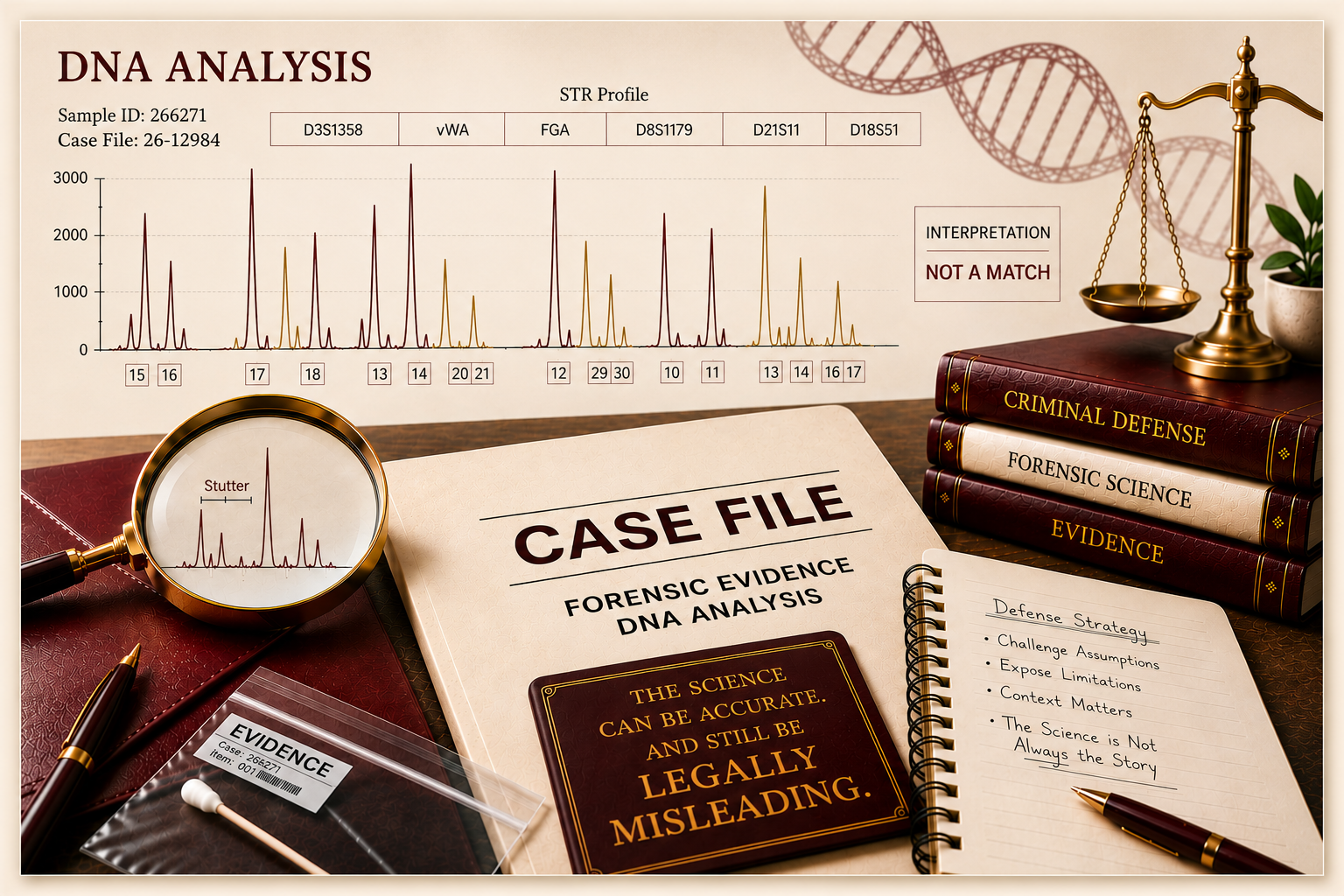
DNA Stutter Explained: Why Small Peaks Can Create Big Problems in Criminal Cases – What a Defendant Needs to Know About DNA Stutter

In modern criminal prosecutions, DNA evidence is often treated as the gold standard—objective, scientific, and nearly infallible. But the reality is more complex. Small technical artifacts, like DNA “stutter,” can significantly impact how evidence is interpreted and presented in court. If you are facing charges involving forensic evidence, it is critical to work with an…

What DNA Evidence Really Proves in Assault Cases (And What Prosecutors Don’t Tell Juries)

By a criminal defense attorney with a love of forensic DNA litigation DNA evidence carries enormous persuasive power in modern courtrooms. In assault prosecutions, it is increasingly presented as a scientific anchor for the State’s version of events. Jurors hear phrases like “DNA links the defendant to the victim” or “the science proves contact,” and…

DNA Testing in Misdemeanor vs. Felony Offenses in Minnesota

When Is DNA Evidence Used in Minnesota Misdemeanor and Felony Cases? In Minnesota, DNA evidence is most commonly associated with felony-level criminal cases, but it can also play a major role in misdemeanor and gross misdemeanor prosecutions. As forensic science has improved, laboratories can detect smaller amounts of biological material than ever before. Because of…

Probabilistic Genotyping Software: How It Is Used in Criminal Cases

Common Criminal Cases That Use Probabilistic Genotyping DNA Evidence Probabilistic genotyping has become a major part of modern forensic DNA analysis, especially in cases involving complex, degraded, or mixed DNA samples. Unlike traditional DNA interpretation, which works best with clean single-source samples, probabilistic genotyping is designed to evaluate DNA mixtures that may otherwise be difficult…

Probabilistic Genotyping Software in Criminal Cases – What is it?

What Is Probabilistic Genotyping Software in Criminal Cases? In the last decade, courts have increasingly treated DNA evidence as the ultimate truth—an unquestionable form of science that can supposedly prove guilt beyond doubt. That belief has been fueled by crime shows, high-profile exonerations, and courtroom arguments that present DNA as a near-magical link between a…

DNA in Drug Crimes: When Is DNA Used—and When Is It Misused?

I. Introduction: Why DNA Is Showing Up in Drug Cases at All For decades, drug crimes were understood—by investigators, attorneys, and courts alike—as fundamentally non-biological offenses. Unlike violent crimes involving bloodshed, sexual assault, or physical struggle, narcotics cases traditionally centered on contraband itself, not the biology of the people allegedly connected to it. The core…

Understanding DNA Evidence, Its Use in Minnesota Courts, and the Defense Role

Forensic DNA evidence is one of the most important scientific tools used in modern criminal investigations. DNA — short for deoxyribonucleic acid — is often described as a genetic blueprint because it contains the biological instructions that determine many of a person’s inherited characteristics. Nearly every cell in the human body carries the same DNA,…